

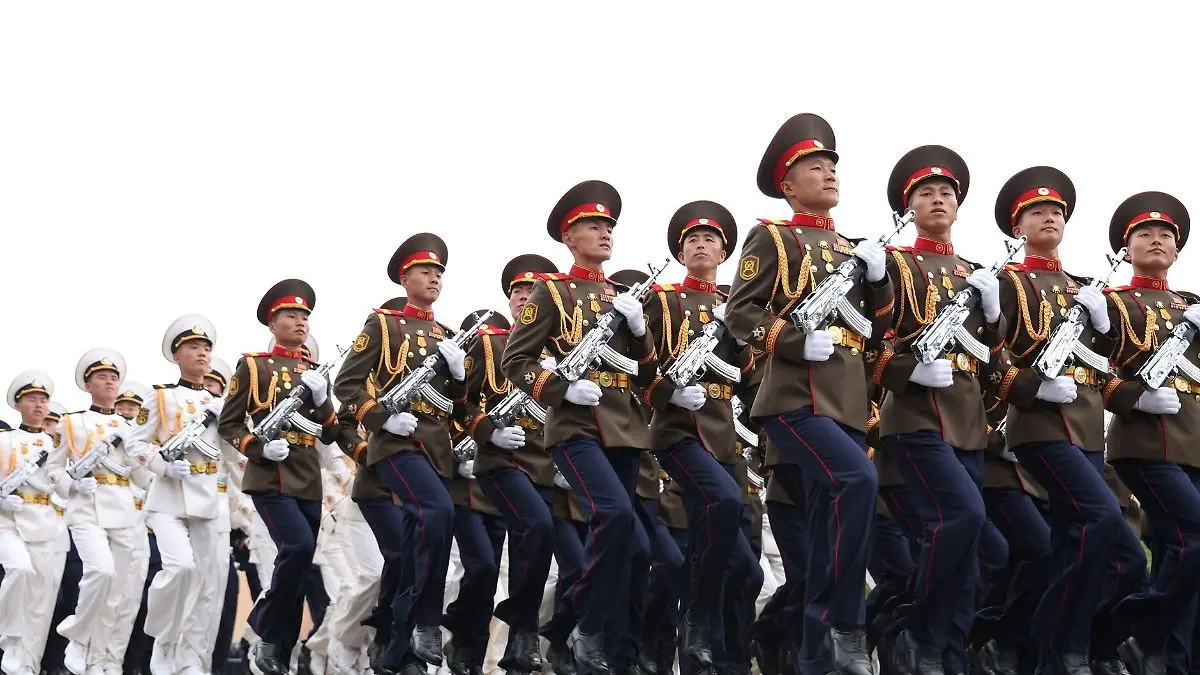
North Korean leader Kim Jong Un has directed senior military officials to significantly bolster forces along the border with South Korea, according to state-run media reports. During a meeting with high-ranking commanders, Kim outlined what he described as a 'policy of territorial defense' aimed at fortifying the front-line units and turning the demarcation line into an 'impregnable fortress.' The Korean Central News Agency (KCNA) specified that the orders are part of a broader strategy to prevent conflict through a show of overwhelming strength.
The briefing, held at an undisclosed location, featured Kim standing before uniformed officers in an ornate parade hall. Photographs released by KCNA showed the leader gesturing toward maps and charts, emphasizing the urgency of the situation. According to the regime's official narrative, Kim spoke of a 'great transformation' in the country's defensive capabilities and instructed commanders to sharpen their posture against the 'arch-enemy,' a clear reference to South Korea.
This development marks a significant escalation in North Korea's military stance, which has oscillated between negotiation and provocation for decades. The Korean Peninsula has been technically at war since the 1950-1953 Korean War ended with an armistice, not a peace treaty. The Demilitarized Zone (DMZ) that separates the two Koreas is one of the most heavily fortified borders in the world, with an estimated 1.2 million North Korean troops deployed along its northern side. Kim's latest orders appear to be accelerating a years-long buildup of conventional and unconventional forces.
During the meeting, Kim and his commanders discussed 'plans to strengthen front-line troops and other key units in military-technical terms as an important decision for more effective war deterrence.' State media further cited Kim as instructing that projects to modernize the military should be 'accelerated to redefine the operational concept in all areas.' This language suggests that North Korea is not merely adding personnel but also upgrading equipment, communications, and doctrine. Analysts have noted that Pyongyang has been investing heavily in new missile systems, including intercontinental ballistic missiles and hypersonic glide vehicles, as well as in its cyber and electronic warfare capabilities.
The timing of the border reinforcement is critical. In early 2026, Kim declared at a party congress that South Korea is 'the most hostile state to us,' a departure from previous decades of rhetoric that focused on eventual reunification. This shift has been accompanied by the dismantling of symbols of inter-Korean cooperation, including the demolition of the Arch of Reunification in Pyongyang and the severing of military hotlines. In March of this year, North Korea fired a volley of artillery shells into the buffer zone near the Northern Limit Line, prompting South Korea to conduct live-fire drills in response.
The escalation is also tied to broader geopolitical dynamics. The United States and South Korea have intensified joint military exercises, including the Freedom Shield drills, which North Korea condemns as preparations for invasion. China, North Korea's principal ally, has called for restraint but has not publicly endorsed Pyongyang's aggressive posture. Russia, another traditional supporter, has been preoccupied with its war in Ukraine, potentially reducing its ability to influence events on the Korean Peninsula.
Kim's decision to reinforce the border while simultaneously claiming to avert war is a classic strategy of deterrence through strength. By making the border more dangerous for any potential attacker, he hopes to create a situation where neither side can risk a first move. However, this tactic carries inherent risks, as miscalculations or accidental clashes could spiral into a full-scale conflict. The area is already notorious for incidents such as the 2010 shelling of Yeonpyeong Island, which killed four South Koreans, and the 2015 landmine explosions that maimed two South Korean soldiers.
Internally, the military buildup serves multiple purposes. It reinforces Kim's image as a strong leader committed to defending the nation, which is crucial for domestic legitimacy. It also provides a justification for maintaining the regime's grip on resources and society, as the country remains one of the most militarized in the world, with a defense budget estimated at 20-30% of GDP. The parade uniforms worn by the commanders at the meeting underscore the regime's emphasis on martial symbolism and loyalty.
The international community has reacted with concern. The United Nations Command, which oversees the armistice, has called for de-escalation. The South Korean Ministry of Unification stated that it is closely monitoring the situation and maintaining readiness. However, there is a sense of fatigue among diplomats, who have seen numerous cycles of tension and dialogue fail to produce lasting peace. The last major summit between Kim and then-U.S. President Donald Trump in 2019 collapsed over disagreements on sanctions relief and denuclearization.
In the weeks since Kim's meeting with commanders, satellite imagery has shown increased activity at North Korean border posts, including the deployment of additional artillery units and construction of new bunkers. Defectors and intelligence sources report that troops have been issued new instructions on engagement rules and are conducting more frequent patrols. The rhetoric from Pyongyang remains bellicose, with state media publishing editorials that describe South Korea as a 'puppet state' and the U.S. as an 'imperialist aggressor.' Yet, Kim's own framing of the troop movement as a war-prevention measure suggests he is aware of the catastrophic consequences that a full-scale conflict would have for his regime, which values survival above all.
Historically, North Korea has used brinkmanship to extract concessions, such as aid or security guarantees. Whether this latest move is another iteration of that strategy or a genuine step toward war remains unclear. What is certain is that the border between the two Koreas is once again a flashpoint, with Kim Jong Un playing a high-stakes game of military chicken while insisting his goal is peace.
Source: ntv.de News