

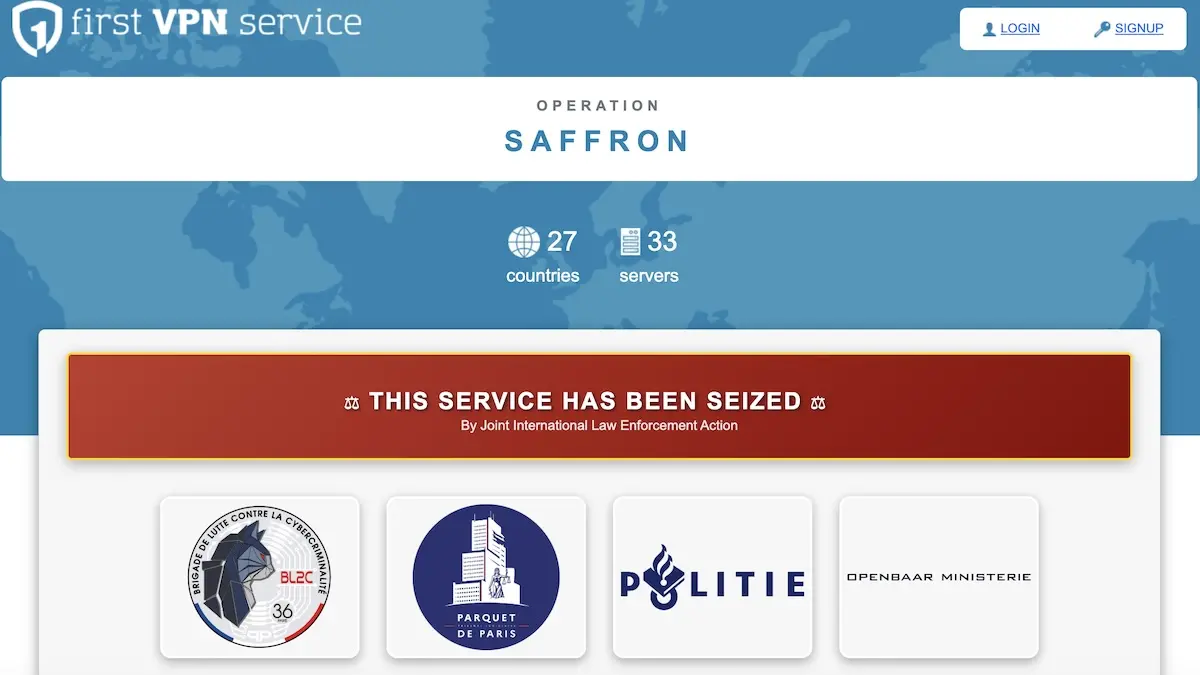
Authorities in North America and Europe have successfully disrupted First VPN, a popular cybercrime service that has been used by ransomware groups and other malicious actors for over a decade. The operation resulted in the arrest of the alleged administrator in Ukraine and the dismantling of critical infrastructure supporting criminal activities.
According to the Federal Bureau of Investigation (FBI), First VPN had been operational since 2014, providing 32 exit nodes spread across 27 countries at the time of its disruption. The service was primarily advertised on Russian-language dark web forums, where it marketed itself as a reliable anonymization tool for cybercriminals. Investigators found that at least 25 different ransomware groups relied on First VPN for network reconnaissance, initial access, and data exfiltration during attacks.
The FBI released a detailed alert containing technical indicators of compromise (IoCs), mappings to the MITRE ATT&CK framework, and recommended detection and mitigation strategies. IP addresses associated with First VPN were linked to a wide range of malicious activities, including network scanning, botnet operations, distributed denial-of-service (DDoS) attacks, and unauthorized intrusions into corporate networks. The service effectively acted as a digital camouflage, allowing threat actors to mask their true locations and evade law enforcement tracking.
Europol, the European Union’s law enforcement agency, coordinated the international operation. Law enforcement teams and their partners dismantled 33 servers that formed the backbone of First VPN’s infrastructure. The takedown specifically targeted the domains 1vpns.com, 1vpns.net, 1vpns.org, and corresponding onion addresses on the Tor network. The alleged administrator was apprehended in Ukraine, though authorities have not yet released his identity.
In a statement, Europol emphasized that users of the criminal service have been notified of the shutdown and informed that they have been identified. Information on 506 users was shared internationally with law enforcement agencies in multiple countries, enabling further investigations into their activities. This marks one of the most significant disruptions of a cybercrime anonymization service in recent years.
Bitdefender, a cybersecurity firm that participated in the operation, noted that the 506 identified users represent only a subset of First VPN’s total customer base. Investigators are now working to link these users to specific criminal operations. Some are expected to be connected to known ransomware groups, while others may reveal previously unknown fraud operations, data theft campaigns, or cybercrime-as-a-service infrastructure. Bitdefender’s researchers commented that while new anonymization services will inevitably emerge to fill the gap, each successful takedown shortens the operational window of subsequent services and raises the barrier for actors who rely on turnkey solutions.
“First VPN advertised itself as a service criminals could trust to keep them beyond law enforcement’s reach. The operation proved that claim wrong, and every actor evaluating the next anonymization service now knows the same risk exists,” Bitdefender added in its analysis.
To understand the broader context, it is important to recognize the role that VPNs play in the cybercrime ecosystem. While legitimate VPN services are used by millions of people worldwide for privacy and security, cybercriminals often abuse them to hide their IP addresses, bypass geographic restrictions, and evade detection. Services like First VPN specifically catered to this illicit market by offering exit nodes in jurisdictions with weak cybercrime enforcement, accepting cryptocurrency payments, and providing easy integration with common hacking tools.
Ransomware groups, in particular, have increasingly relied on such anonymization services to conduct initial reconnaissance and maintain persistent access to victim networks. The LockBit gang, the Conti group, and many others have been known to use bulletproof hosting and VPN services to avoid attribution. By disrupting First VPN, law enforcement has not only removed a key enabler but also collected valuable intelligence on the operators and their clients.
The takedown of First VPN follows a pattern of successful international operations against cybercrime infrastructure. In recent years, authorities have targeted similar services such as RedVDS, which was disrupted by Microsoft and law enforcement, and the Kimwolf DDoS botnet, which was dismantled in a separate operation. These actions demonstrate the growing collaboration between public and private sectors in combating cybercrime. However, the challenge remains significant: the cybercrime-as-a-service economy is highly resilient, and new services often appear quickly to replace those that are taken down.
Experts note that the arrest of the administrator in Ukraine is particularly notable. Ukraine has become a critical partner in global cybercrime investigations, especially following the Russian invasion in 2022, which prompted many Ukrainian law enforcement agencies to intensify their cooperation with Western counterparts. This operation underscores the importance of international collaboration in identifying and apprehending cybercriminals who operate across borders.
From a technical perspective, the FBI’s alert provides valuable information for network defenders. The IoCs include specific IP addresses, domain names, and SSL certificate fingerprints associated with First VPN’s infrastructure. Organizations are advised to review their logs for connections to these indicators and to implement the recommended MITRE ATT&CK mappings to strengthen their detection capabilities. The FBI also suggests monitoring for unusual outbound VPN traffic, especially to countries that are not typical for the organization’s operations.
Despite this success, cybersecurity experts caution that the impact on overall cybercrime may be temporary. The market for anonymization services is driven by strong demand from criminals who require operational security. New services will likely emerge, possibly with improved security measures to avoid similar takedowns. However, each disruption forces criminals to rebuild their infrastructure, potentially leaving traces that law enforcement can exploit. It also sends a deterrent message to potential users that their anonymity is not guaranteed.
The case of First VPN highlights the ongoing cat-and-mouse game between cybercriminals and law enforcement. As technology evolves, so do the methods used by both sides. The FBI and Europol have indicated that they will continue to target services that enable ransomware and other forms of cybercrime. Information sharing between agencies and the private sector remains a critical component of these efforts.
In the wake of the takedown, organizations are advised to stay vigilant. While First VPN is no longer operational, the 506 identified users may still pose a threat. Some of these users could pivot to other services or attempt to rebuild their own anonymization infrastructure. Security teams should monitor for any signs of re-emergence of similar services and update their threat intelligence accordingly.
This operation also serves as a reminder of the importance of proactive hunting and threat intelligence. By working with cybersecurity firms like Bitdefender, law enforcement can gain insights into criminal operations that are not available through traditional investigative methods. The collaboration between public and private sectors is likely to deepen as cyber threats continue to evolve.
The impact of the First VPN disruption will be felt in the ransomware ecosystem for some time. Smaller groups that relied heavily on this service may struggle to maintain their operations, at least temporarily. Larger groups with more resources may adapt quickly, but the loss of a trusted service introduces uncertainty. This operational friction can give defenders an edge in detecting and responding to attacks.
In conclusion, while no single takedown can eliminate cybercrime, the disruption of First VPN represents a significant tactical victory. It demonstrates that law enforcement can penetrate even the most secretive cybercrime services and hold their operators accountable. The arrest of the administrator in Ukraine sends a clear signal that engaging in cybercrime-as-a-service carries real consequences. As the digital landscape continues to evolve, such operations will remain a crucial tool in the fight against cyber threats.
Source: SecurityWeek News