

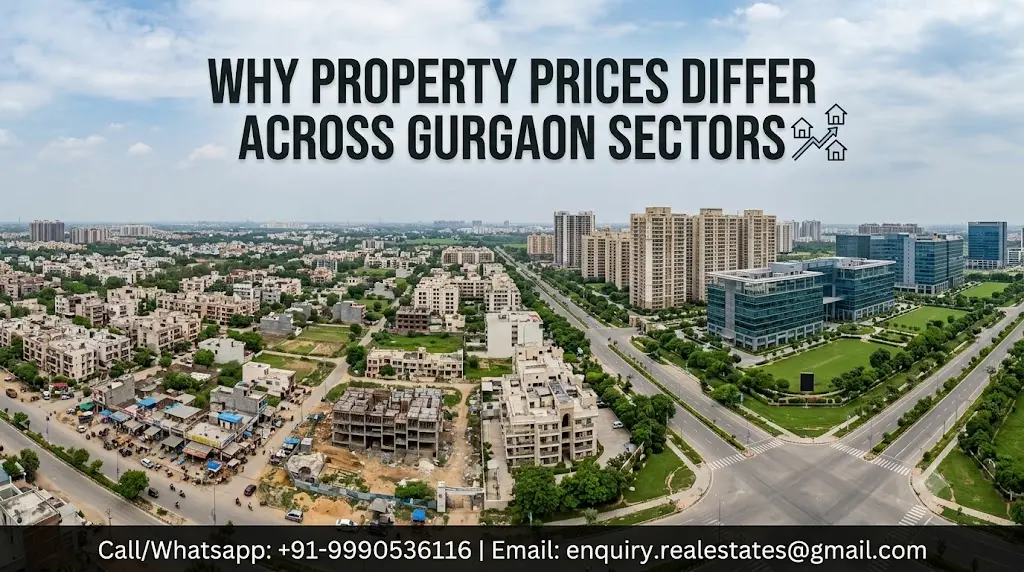
The real estate ecosystem in Northern India's premier corporate and technological megacity exhibits remarkable valuation variance. A single turn off a major expressway can take a buyer from sectors where high-rise apartments average ₹12,000 per sq. ft. to adjacent corridors where ultra-luxury residences command upwards of ₹40,000 per sq. ft. Understanding the underlying forces behind these price variations is essential for anyone evaluating real estate across Millennium City. Buyers exploring options like an Ireo New Project township or comparing secondary market listings along Golf Course Road, Golf Course Extension Road, Dwarka Expressway, and Southern Peripheral Road (SPR) must look beyond basic floor plans and promotional rates.
Navigating this dynamic landscape requires evaluating how location, infrastructure density, spatial loading efficiency, developer tiering, and statutory charges shape real market prices. Whether you are reviewing an Ireo New Project Gurgaon master plan or assessing newly launched high-rises along arterial transit corridors, understanding these valuation drivers will help you identify strong investment opportunities, negotiate effectively, and protect your capital. This definitive, expert-level guide breaks down the core reasons behind sector-wise price disparities across Gurgaon in 2026.
Why Property Prices Differ Across Gurgaon Sectors
Key Factors Explaining Why Property Prices Differ Across Gurgaon Sectors
Property prices across Gurgaon sectors do not move in isolation. They are driven by a combination of location dynamics, infrastructure quality, developer execution, and market demand. Examining these core factors helps explain why price tags vary so significantly between neighboring sectors.
Geographic Proximity to Key Business Hubs and Transit Arteries
Distance to primary commercial districts remains the single biggest factor influencing land and apartment valuations across Gurgaon. Sectors situated directly along established business corridors—such as Cyber City, Golf Course Road, and Horizon Center—command significant location premiums.
- The Cyber Hub Effect: Sectors located within a 5-to-10-minute drive of Cyber City or Golf Course Road benefit from high tenant demand from senior corporate executives, maintaining low vacancy rates and strong land values.
- Expressway Transit Nodes: The operational maturity of major arterial transit expressways, such as Dwarka Expressway (Northern Peripheral Road), Central Peripheral Road (CPR), and Southern Peripheral Road (SPR), has created distinct price zones along their routes. Sectors with direct, uninterrupted access to these expressways trade at noticeable premiums compared to interior sectors accessed via narrower local roads.
- Airport Accessibility: Direct access to Indira Gandhi International (IGI) Airport via Dwarka Expressway or NH-48 adds a key accessibility premium, particularly for multinational executives, NRIs, and frequent business travelers.
Civic Infrastructure Readiness and Public Amenity Density
Price disparities between sectors often reflect differences in municipal infrastructure completeness. Sectors with fully operational civic networks command higher valuations than sectors where infrastructure remains under development:
- Road Grid Widths: Sectors featuring 60-meter to 90-meter master-plan sector roads with organized service lanes experience better traffic flow and command higher buyer preference.
- Municipal Utilities: Sectors connected to municipal water supply lines, operational underground drainage systems, and dual-source power grids carry lower operational costs and higher property valuations.
- Social Infrastructure: The density of top-tier IB/CBSE schools, multi-specialty tertiary hospitals, and organized retail centers within a 3-kilometer radius directly lifts sector demand and residential pricing.
Understanding the All-Inclusive Cost sheet Breakdown
A common challenge when comparing sector prices is relying solely on the advertised Basic Sale Price (BSP). The BSP typically represents only 65% to 75% of the true financial outlay. To compare properties accurately across different sectors, buyers must calculate the all-inclusive acquisition cost.
Carpet Area Normalization and Loading Ratios
Under the Real Estate (Regulation and Development) Act (RERA), developers are legally required to quote and sell properties based on net usable Carpet Area. However, gross pricing quotes often reference Super Area, introducing variations in unusable space.
In Gurgaon high-rises, loading factors typically range from 28% to 38%. A project with a 28% loading factor provides significantly more usable living space per rupee spent than a project with a 38% loading factor offered at a slightly lower quoted BSP.
Statutory Fees and Government Taxes
Statutory levies apply across all sectors, but their impact varies based on overall property value:
- External Development Charges (EDC) & Infrastructure Development Charges (IDC): Mandatory government fees collected for master-plan infrastructure such as sector roads, water mains, and trunk sewer lines.
- Goods and Services Tax (GST): Under-construction flats carry a flat 5% GST without Input Tax Credit (ITC). Properties that have received a valid Occupation Certificate (OC) are completely exempt from GST.
- Stamp Duty and Registration Fees: Haryana stamp duty rates are set at 6% for male buyers, 4% for female buyers, and 5% for joint male-female registrations.
Mandatory Non-BSP Capital Charges
When comparing developer cost sheets across sectors, factor in these mandatory line items:
- Car Parking Allocation: Covered car parking fees range between ₹4,00,000 and ₹8,00,000 per dedicated parking bay.
- Clubhouse Membership Fee: One-time charges ranging from ₹3,50,000 to ₹7,50,000 for access to recreational amenities.
- Interest-Free Maintenance Security (IFMS): A one-time corpus deposit (typically ₹100–₹250 per sq. ft.) collected prior to possession and transferred to the Resident Welfare Association (RWA).
Sector-Wise Micro-Market Price Matrix (2026 Benchmarks)
The table below outlines pricing metrics, historic growth rates, and rental yields across primary micro-markets in Gurgaon:
Detailed Micro-Market Valuation Analysis
Golf Course Road Belt (Sectors 24 to 42)
Golf Course Road is Northern India's premier real estate corridor, with luxury high-rises trading between ₹28,000 and ₹48,000 per sq. ft. Limited land availability, direct Rapid Metro access, and proximity to high-end commercial hubs like One Horizon Center keep property values high.
Due to steep entry costs, this corridor functions primarily as a wealth-preservation asset class for high-net-worth individuals, delivering stable long-term value retention rather than rapid percentage growth.
Golf Course Extension Road Belt (Sectors 58 to 67A)
Golf Course Extension Road offers a balance of premium lifestyle amenities and steady capital growth potential. Properties in this corridor range from ₹16,500 to ₹26,000 per sq. ft.
Master-planned township developments, such as Ireo The Corridors in Sector 67A, showcase how gated communities along Golf Course Extension Road provide integrated sports complexes, multi-tier security, and fast connectivity to commercial hubs along Cyber City and Sohna Road.
Southern Peripheral Road (SPR) and Sector 67A Micro-Market
Southern Peripheral Road connects Golf Course Extension Road directly to NH-48, with property values averaging between ₹14,000 and ₹22,500 per sq. ft. Micro-markets along SPR feature low-density layouts, wide sector roads, and integrated residential communities.
Developments such as Ireo Corridors Sector 67A Gurgaon highlight how master-planned gated enclaves combine residential luxury with strong rental demand from enterprise tech hubs along Sohna Road and SPR. End-users evaluating Ireo Corridors or neighboring projects in Ireo Corridors Sector 67A benefit from ongoing elevated expressway upgrades and direct SPR transit links.
Dwarka Expressway Corridor (Sectors 99 to 113)
The operational maturity of the 29-kilometer Dwarka Expressway has made Sectors 99 through 113 high-growth investment zones. Prices range from ₹13,500 to ₹21,500 per sq. ft.
Key pricing drivers include a 15-minute drive to Indira Gandhi International Airport, direct integration with Central Peripheral Road (CPR), and new high-rise developments equipped with modern community amenities.
New Gurgaon (Sectors 81–95) and Sohna Belt
New Gurgaon offers entry-level rates ranging from ₹8,500 to ₹13,500 per sq. ft. These sectors serve end-users and first-time buyers seeking modern gated communities with direct connections to NH-48 and the Delhi-Mumbai Expressway.
Integrated Townships vs. Standalone Residential Towers
A key structural factor causing price variations within the same sector is the divergence between standalone towers and master-planned gated townships.
Integrated developments such as Ireo Corridors Gurgaon illustrate how master planning creates long-term value. Gated townships feature internal sports arenas, school zones, retail plazas, and managed green open spaces within a secure perimeter. As a result, township properties maintain higher secondary market liquidity and command rental yield premiums over standalone towers.
Regulatory Protections and Developer Track Records
Developer credibility and legal compliance significantly impact unit pricing across all sectors.
Haryana RERA Compliance and Escrow Protections
Under Haryana RERA (HRERA) regulations, developers must deposit 70% of all collected buyer funds into a dedicated project escrow account used exclusively for construction. Projects with clear HRERA compliance, verified land titles, and on-time construction milestones command higher pricing than unverified developments.
Bank Approved Project Financials (APF)
An Approved Project Financials (APF) code from major public and private banks confirms that lenders have verified the project's legal title and technical approvals. Bank approval reduces risk for buyers and supports better resale value.
Emerging Growth Vectors Shaping Sector Prices (2026–2030)
Several key trends will influence sector valuations across Gurgaon over the coming decade:
- Transit-Oriented Development (TOD) Policy: Higher Floor Area Ratio (FAR) allowances along metro corridors will encourage vibrant mixed-use hubs, driving valuations around transit interchanges.
- Global Capability Centers (GCCs) Expansion: The expansion of Fortune 500 GCCs and corporate campuses continues to fuel demand for 3 BHK and 3.5 BHK luxury residences equipped with home office space.
- Smart Infrastructure and Sustainability: Green building certifications (IGBC/LEED), solar integration, rainwater harvesting, and EV charging bays are becoming standard requirements that enhance property resale values.
Step-by-Step Action Plan for Property Buyers
To navigate sector-wise price differences effectively, follow this structured checklist:
- Calculate Total Acquisition Cost: Add 20% to 35% to the quoted BSP to account for PLCs, EDC/IDC fees, GST, stamp duty, parking, and IFMS deposits.
- Normalize Quotes to Net Carpet Area: Convert property quotes to a price per square foot of usable carpet area to eliminate loading discrepancies.
- Verify HRERA and Bank APF Status: Confirm project registration details on the official Haryana RERA portal and verify bank approvals.
- Conduct On-Site Physical Inspection: Inspect sector road widths, water supply connections, power backup infrastructure, and surrounding commercial developments.
- Opt for Construction-Linked Payment Plans: Choose milestone-based payment schedules that release funds only after certified construction progress.
- Look Beyond Basic Sale Price: The Basic Sale Price accounts for only 65% to 75% of the total acquisition cost. Always factor in PLCs, EDC/IDC fees, GST, stamp duty, car parking, and IFMS deposits.
- Normalize Costs by Net Carpet Area: Compare properties using net carpet area efficiency rather than gross super area to ensure accurate space-value comparison.
- Micro-Market Positioning Impacts Returns: Golf Course Extension Road, Sector 67A, and Southern Peripheral Road (SPR) provide an optimal balance of strong rental yields (4.1%–4.7%) and steady capital growth.
- Townships Outperform Standalone Towers: Integrated gated townships retain higher secondary market liquidity and command higher rental yields than standalone residential towers.
- Verify HRERA Escrow Compliance: Confirm project registration and escrow account details on the official Haryana RERA web portal before issuing booking deposits.
Frequently Asked Questions
What are the main reasons why property prices differ across Gurgaon sectors?
Property prices differ across Gurgaon sectors due to proximity to commercial hubs like Cyber City, direct access to expressways, municipal infrastructure completeness, loading ratios, developer track record, and social amenity density.
How much extra should buyers budget beyond the Basic Sale Price (BSP)?
Buyers should budget an additional 20% to 35% above the quoted BSP to cover Preferential Location Charges (PLCs), EDC/IDC fees, GST, stamp duty, car parking allocation, club fees, and IFMS deposits.
What is the difference between Super Area and Net Carpet Area under RERA?
Carpet area is the net usable floor space inside apartment walls. Super area includes common lobbies, elevator shafts, corridors, and clubhouses. Under HRERA, developers must sell properties strictly based on carpet area.
Which Gurgaon sectors offer the best balance of affordability and connectivity?
Sectors along Southern Peripheral Road (SPR, including Sector 67A), Golf Course Extension Road, and Dwarka Expressway offer a strong mix of modern infrastructure, expressway access, and capital appreciation potential.
How does HRERA protect property buyers in Gurgaon?
HRERA mandates that developers deposit 70% of collected buyer funds into a dedicated escrow account for construction, enforces delivery schedules with mandatory delay penalties, and prohibits layout modifications without buyer consent.
What is the current stamp duty rate for property registration in Haryana?
Stamp duty rates in Haryana are 6% for male buyers, 4% for female buyers, and 5% for joint male-female property registrations, along with standard registration processing fees.
Is GST applicable on all residential property purchases in Gurgaon?
No, a 5% GST applies only to under-construction properties without Input Tax Credit. Properties that have received an official Occupation Certificate (OC) are completely exempt from GST.
Why do integrated gated townships command higher prices than standalone towers?
Integrated townships offer multi-tier security, dedicated sports facilities, green open spaces, on-site retail, and professional facility management, driving higher rental yields and superior resale liquidity.
What hidden costs should buyers watch for on developer cost sheets?
Key additional line items include External Development Charges (EDC/IDC), Preferential Location Charges (PLC), Floor Rise surcharges, Club Membership fees, Parking allocation, IFMS deposits, and GST.
How does the loading factor affect apartment space efficiency?
The loading factor represents the percentage difference between gross super area and net carpet area. A lower loading percentage means you pay for more functional interior living space per rupee spent.
What payment plan offers the lowest risk for homebuyers?
A Construction-Linked Plan (CLP) offers the lowest financial risk because installment payments are released in tranches tied directly to certified construction milestones on-site.
How can I check if a project has bank APF approval?
Ask the developer for the project's Approved Project Financials (APF) code issued by major public or private banks. Bank approval indicates that the institution has verified land titles and project approvals.
Why are 3 BHK and 3.5 BHK units more popular than 2 BHK flats in Gurgaon?
The widespread adoption of hybrid work arrangements has increased demand for home offices and extra study space, making 3 BHK and 3.5 BHK layouts the most sought-after configurations for end-users.
What is Interest-Free Maintenance Security (IFMS)?
IFMS is a one-time corpus deposit collected by the developer prior to possession and subsequently transferred to the Resident Welfare Association (RWA) to fund long-term building maintenance.
Are properties along Southern Peripheral Road (SPR) good for long-term investment?
Yes, SPR offers strong investment potential due to ongoing elevated road upgrades, metro extensions, direct links to NH-48 and Golf Course Extension Road, and close proximity to major corporate office complexes.
Final Thoughts
Understanding why property prices differ across Gurgaon sectors is key to making smart real estate investments in Northern India's top corporate hub. By normalizing property quotes on a net carpet area basis, factoring in mandatory statutory levies, verifying HRERA escrow compliance, and choosing milestone-linked payment plans, buyers can protect their capital and secure high-value residential assets.
Whether you are evaluating modern high-rises along Dwarka Expressway, expanding corridors along Southern Peripheral Road, or master-planned integrated townships across Golf Course Extension Road and Sector 67A, thorough financial planning ensures you make an informed purchase in Gurgaon's dynamic property market.