

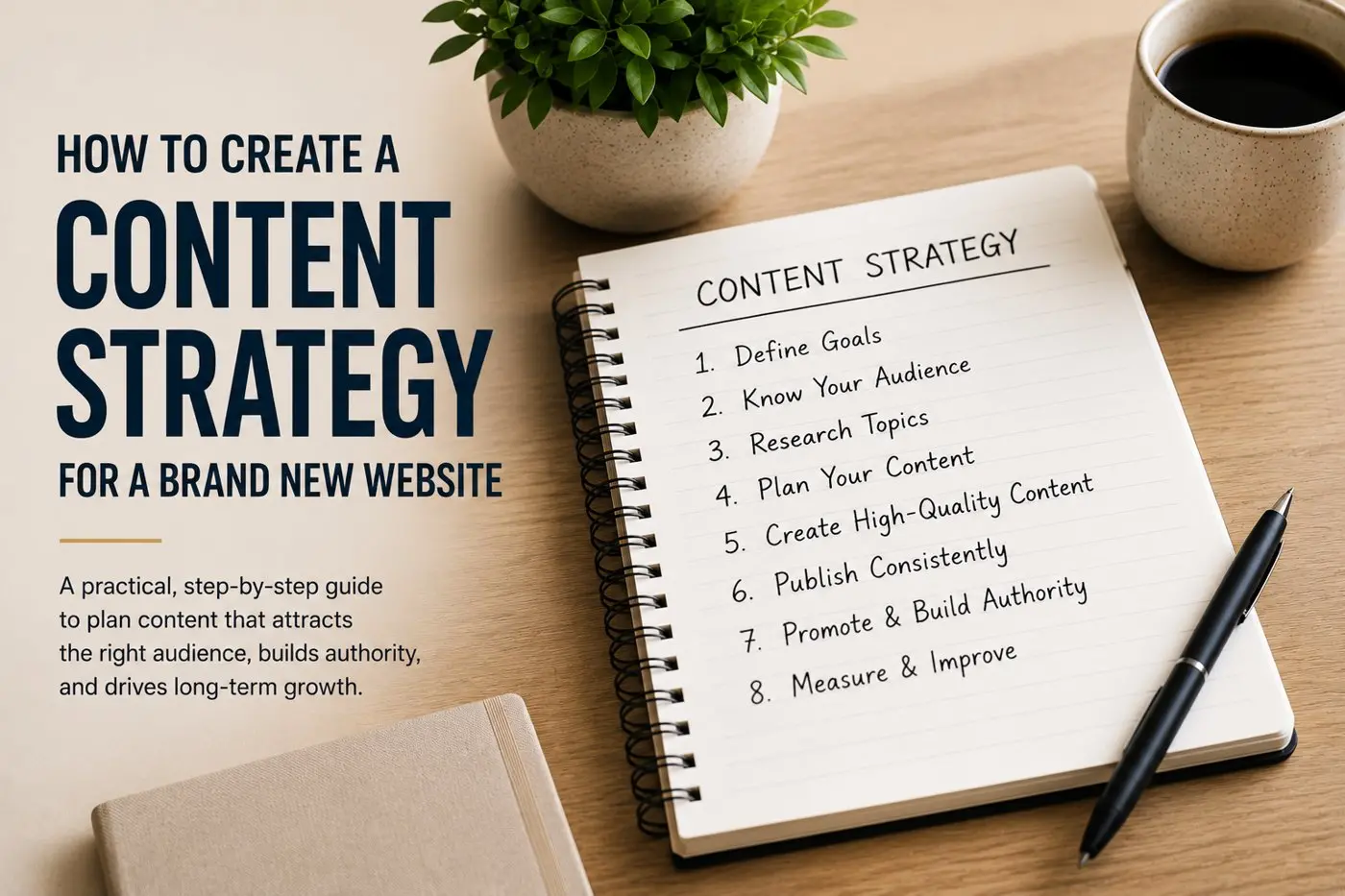
Creating a content strategy for a brand new website can feel weirdly overwhelming. You launch the site, stare at an empty blog section, and suddenly every marketing guru online is telling you to publish daily, dominate search engines, and build authority overnight.
Here's the thing: most new websites don't fail because of bad design. They fail because they publish random content with no direction.
A proper new website content strategy gives you structure from day one. It helps you decide what to publish, who you're targeting, and how your content can actually drive traffic, leads, and sales over time instead of becoming another forgotten blog archive.
If you're starting from scratch, this guide will help you build a content plan that makes sense in 2026 and beyond.
What Is a Content Strategy for a Brand New Website?
Content strategy: A structured plan that decides what content you'll create, who it's for, why it matters, and how it supports your business goals.
A lot of people confuse content strategy with “writing blog posts.” That's only part of it.
A real website content plan covers:
- Your target audience
- Search intent and keyword research
- Core website pages
- Publishing frequency
- Content formats
- Internal linking
- Conversion goals
Think of it like building the blueprint before constructing a house.
Without strategy, you end up publishing articles that don't rank, pages nobody visits, or content that attracts traffic but never converts.
In my experience, new site owners usually make one of two mistakes:
- They publish too little because they overthink everything.
- They publish too much low-quality content hoping Google will magically reward volume.
Neither works very well anymore.
Modern SEO rewards topical authority, usefulness, and consistency more than raw quantity.
Why a New Website Content Strategy Matters in 2026
Search engines are smarter now. AI-generated fluff is everywhere, and honestly, users can spot empty content faster than most marketers think.
That changes the game for brand-new websites.
Back in the day, you could throw together 300-word keyword-stuffed articles and still rank. That's fading quickly. In 2026, search engines care more about:
- Search intent satisfaction
- Content depth
- Topical relevance
- User engagement
- Real expertise signals
What most people overlook is this: a new website has no trust yet.
No backlinks. No history. No authority.
Your content becomes the first trust signal.
Let's say you launch a fitness website. Publishing random articles like “Best Protein Powder” before building foundational content probably won't move the needle. But creating beginner guides, workout plans, nutrition basics, and interconnected educational content can slowly establish relevance.
I've seen small niche sites outrank giant competitors simply because their content structure made more sense.
One realistic example:
A startup home-cleaning company launched a local service website with only six pages and a small blog. Instead of targeting huge competitive keywords immediately, they focused on practical homeowner questions like:
- How often should carpets be cleaned?
- What's safe for pet stains?
- DIY vs professional deep cleaning
Within eight months, organic traffic grew steadily because the content solved actual problems.
No viral tricks. Just useful planning.
Expert Tip: Before writing anything, identify your “money pages” first. Those are the pages tied directly to services, products, or conversions. Your blog content should support those pages, not distract from them.
How to Create a Content Strategy for a Brand New Website Step by Step
1. Define Your Target Audience Clearly
You can't create useful content if you're trying to speak to everyone.
Start by asking:
- Who is this website really for?
- What problems do they have?
- What are they searching before buying?
- What level of knowledge do they already have?
A beginner audience needs simple educational content.
An advanced audience wants deeper insights, comparisons, and case studies.
Be specific.
“Small business owners” is too broad.
“Local bakery owners struggling with online visibility” is far better.
That difference changes your entire content direction.
2. Build a Keyword and Topic Map
This is where your SEO content planning starts.
Don't chase giant keywords immediately. New websites rarely rank for highly competitive terms early on.
Instead, focus on:
- Long-tail keywords
- Question-based searches
- Low-competition informational topics
- Problem-solving content
Group related keywords into clusters.
For example, if your site is about email marketing:
Main topic: Email marketing for beginners
Supporting topics:
- How to write email subject lines
- Best welcome email examples
- Email open rate mistakes
- How often should you send newsletters?
This structure helps search engines understand your expertise.
And honestly, it makes content creation less chaotic too.
3. Create Core Website Pages First
Here's a slightly unpopular opinion.
Your blog should not be the first priority.
Most new sites should first create:
- Homepage
- About page
- Service or product pages
- Contact page
- Basic trust pages
Why?
Because blog traffic without conversion infrastructure is mostly vanity.
I've watched businesses celebrate traffic spikes while generating almost zero revenue because visitors had nowhere meaningful to go.
Build the foundation first.
Then create supporting blog content.
4. Develop a Realistic Publishing Schedule
Consistency beats intensity.
A lot of people burn out trying to publish daily.
For a brand new website, one high-quality article per week is often enough to build momentum.
Especially if each article:
- Targets a clear keyword
- Answers search intent properly
- Includes internal links
- Connects to your services or offers
What matters is sustainability.
You need a system you can maintain for months, not two stressful weeks.
5. Use Internal Linking From the Beginning
Internal linking is one of the easiest SEO wins most beginners ignore.
Every new article should connect naturally to related pages.
That helps:
- Search engines understand topic relationships
- Users stay longer on your site
- Authority flows between pages
A clean content structure almost always performs better than disconnected articles.
6. Measure What Actually Matters
Traffic alone isn't enough.
Track:
- Keyword rankings
- Time on page
- Leads generated
- Click-through rates
- Conversion rates
- Returning visitors
Sometimes an article with only 200 monthly visitors brings more sales than one with 10,000 views.
That's not rare.
That's actually pretty common.
Expert Tip: Create content for the middle of the customer journey, not just the top. Informational traffic is helpful, but comparison and solution-focused content often converts much better.
The Biggest Content Strategy Mistake New Websites Make
Most new websites publish content too broadly.
They try to cover everything.
That's usually a mistake.
Topical focus matters more now than many people realize.
For example, a new finance website trying to cover:
- Credit cards
- Crypto
- Taxes
- Investing
- Insurance
- Real estate
...all at once probably struggles to build authority.
But a site focused specifically on “personal budgeting for freelancers” has a clearer identity.
Search engines understand it faster.
Users trust it faster too.
Here's my hot take: niche depth often beats broad authority during the early growth stage.
That sounds counterintuitive because many marketers push “publish on every topic.” But in most cases, narrower focus builds traction quicker.
Another mistake?
Publishing AI-generated filler without editing.
People can usually tell.
Search engines are getting better at recognizing low-value repetition as well.
Use AI as a drafting assistant if you want. That's practical. But your final content still needs human judgment, examples, opinions, and structure.
Expert Tips and What Actually Works
After working with content-heavy websites for years, I've noticed a few patterns that consistently help new sites grow.
Start with topical clusters, not random articles
One strong cluster of interconnected content often outperforms twenty unrelated blog posts.
Let's say you're launching a website about remote work.
Instead of publishing:
- Random productivity tips
- One cryptocurrency article
- Two mental health posts
- A generic AI news roundup
...build a connected cluster around remote hiring, remote team communication, remote onboarding, and productivity systems.
That's easier for search engines to understand.
Write for readers before algorithms
This sounds obvious, but honestly, a lot of content still reads like it was written purely for bots.
If a paragraph feels robotic when spoken aloud, rewrite it.
Simple test.
Read your introduction out loud.
If it sounds stiff or overly formal, users probably feel that too.
Don't ignore commercial intent
Educational content matters.
But eventually, your content should connect to products, services, consultations, or offers.
Otherwise you're building attention without direction.
A realistic content funnel might look like this:
- Informational blog post
- Related service page
- Case study or proof page
- Contact or conversion page
That's a healthier structure than hoping random traffic converts magically.
Refresh content earlier than you think
New websites especially benefit from updating articles regularly.
Even small updates help:
- New statistics
- Better examples
- Improved formatting
- Updated screenshots
- Additional FAQs
Google tends to reward maintained content over abandoned content.
At least from what I've seen.
Expert Tip: Spend more time improving your first 20 articles than rushing to publish your next 100. Early content quality shapes your site's long-term authority more than people realize.
FAQ - Content Strategy for a Brand New Website
How many blog posts should a new website publish initially?
Most new websites should start with 5–10 strong foundational articles plus essential core pages. Quality matters more than volume early on. A smaller library of genuinely useful content usually performs better than dozens of thin posts.
How long does a new website take to rank on Google?
In most cases, new websites need several months before seeing meaningful organic traffic. Some low-competition keywords can rank faster, but authority generally builds gradually through consistent publishing and optimization.
Should I focus on SEO or user experience first?
You need both, but user experience should guide the strategy. SEO helps people find your content. User experience keeps them engaged once they arrive.
Can AI tools help with content strategy?
Yes, probably more than many people admit. AI tools can speed up keyword research, outlines, and brainstorming. But relying entirely on AI-generated content without editing usually creates bland articles that don't build trust.
A successful content strategy for a brand new website isn't about publishing endless articles or chasing every trending keyword. It's about building focused, useful content that solves real problems and supports clear business goals.
Start small. Stay consistent. Build topical authority step by step.
Over time, that approach compounds.
If you want faster visibility, stronger outreach opportunities, and content placement support, explore professional publishing and promotion services through biphoo.eu. A smart content strategy works even better when paired with proper distribution.