

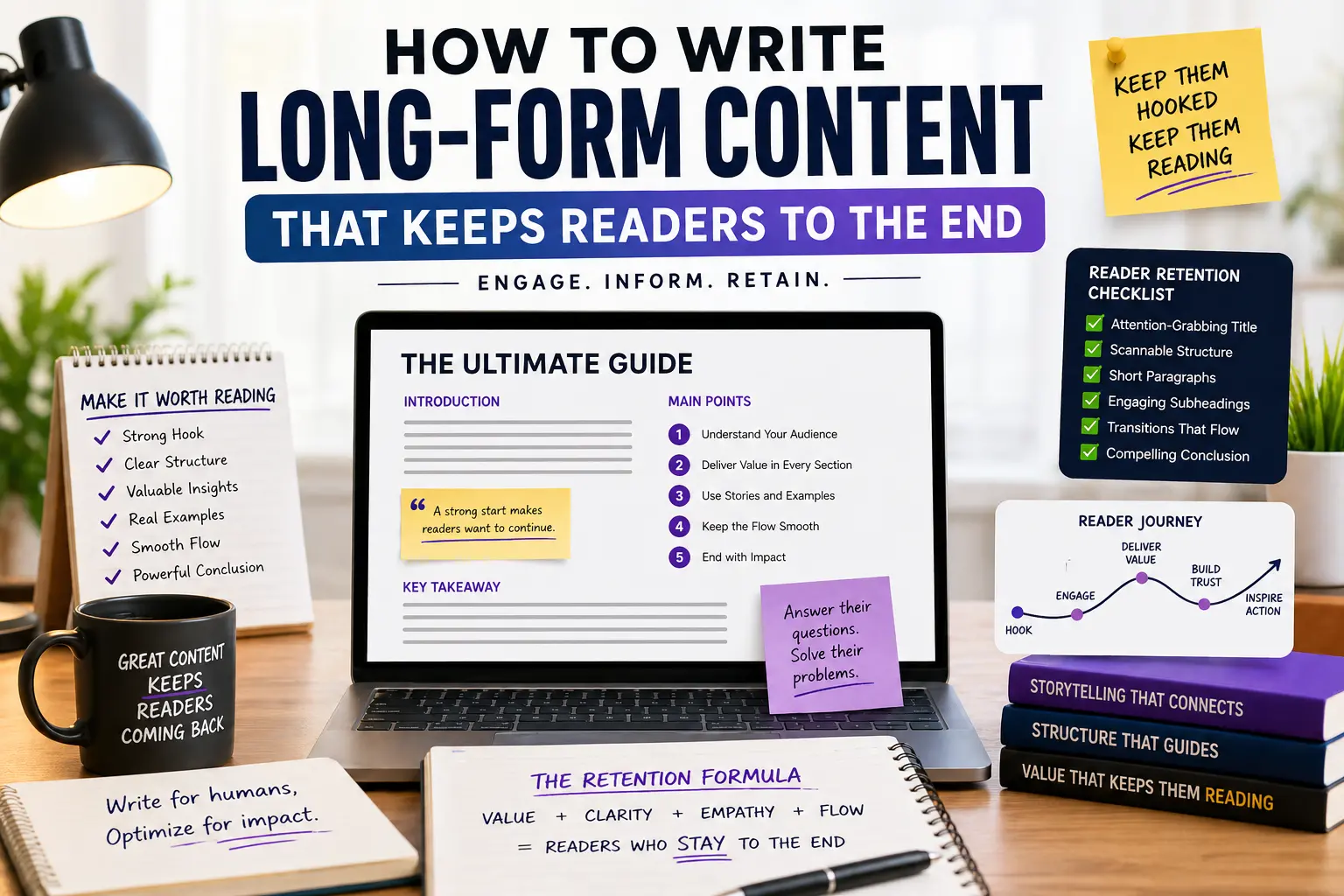
Learning how to write long-form content that actually keeps readers engaged is harder now than it was a few years ago.
Attention spans feel shorter. Content overload is everywhere. And honestly, readers leave pages fast when an article feels bloated or robotic.
That's why reader retention matters more than raw word count.
I've seen 3,000-word articles outperform shorter posts dramatically because they were structured well and genuinely useful. I've also seen painfully long articles lose readers within seconds because they sounded repetitive and lifeless.
Here's the thing: people still read long content.
They just won't tolerate boring content anymore.
If you want better engagement, stronger SEO performance, and more time-on-page, you need a writing approach that keeps momentum from the first paragraph to the final sentence.
What Is Long-Form Content and Why Does It Matter?
Long-form content: Detailed content typically exceeding 1,500 words that explores a topic deeply while maintaining reader engagement and clarity.
Long-form articles aren't simply “long blog posts.”
Good long-form content:
- Answers questions thoroughly
- Builds trust gradually
- Covers multiple search intents
- Keeps readers scrolling
- Encourages sharing and backlinks
- Improves topical authority
A lot of short-form content gets quick clicks.
Long-form content often builds lasting authority.
That's a major difference.
Search engines also tend to reward comprehensive content when it satisfies user intent properly.
But here's what most people misunderstand.
Length alone doesn't improve rankings.
Useful depth does.
You can write 4,000 words of fluff and still lose readers instantly.
In my experience, audience psychology matters more than article length itself.
Readers stay when:
- Information feels practical
- Sections flow naturally
- Examples feel relatable
- Formatting reduces fatigue
- Curiosity keeps building
Why Long-Form Content Matters in 2026
Long-form contentis becoming more valuable because readers are getting better at filtering weak information.
A few years ago, many websites could rank with shallow articles that repeated obvious advice. That approach is fading.
People now compare multiple sources quickly. They skim introductions, scroll through sections, and judge article quality within seconds.
That sounds intimidating, but honestly, it creates a huge opportunity for writers willing to put real effort into their work.
Search engines increasingly reward content that:
- Keeps users engaged longer
- Answers related follow-up questions
- Demonstrates practical experience
- Covers topics comprehensively
- Feels genuinely useful instead of generic
What most people overlook is this: reader retention affects almost every major content goal.
When readers stay longer:
- Bounce rates improve
- More pages get visited
- Conversion opportunities increase
- Social sharing becomes more likely
- Brand trust grows naturally
- Backlinks become easier to earn
Retention compounds over time.
That's why experienced content marketers spend so much energy improving structure and readability.
One thing I've personally noticed is that audiences tolerate length when momentum exists.
Think about documentaries people binge-watch for hours.
Or podcasts lasting three hours.
People don't avoid long experiences.
They avoid boring experiences.
That distinction matters.
Another major shift happening in 2026 involves AI-generated content fatigue.
Readers are becoming suspicious of articles that sound overly polished but emotionally empty.
You can usually feel it.
Every sentence sounds technically correct, yet somehow lifeless.
Human-style long-form content stands out because it includes:
- Real observations
- Imperfect phrasing occasionally
- Emotional rhythm
- Practical nuance
- Unexpected opinions
- Situational examples
That human texture creates trust.
And trust improves retention.
One realistic example involved a SaaS company publishing detailed educational guides about workflow automation.
Their early articles were technically accurate but emotionally flat. Traffic was decent, yet average reading time stayed low.
Later, they rewrote content using:
- More conversational transitions
- Customer examples
- Honest frustrations
- Step-by-step storytelling
- Simpler language
Average session duration improved noticeably.
Readers stayed because the articles felt easier to experience.
Not just easier to understand.
That's an important difference.
Another factor people underestimate is search intent layering.
Strong long-form content doesn't answer only one question.
It anticipates secondary questions naturally.
For example, someone searching “how to write long-form content” may also want to know:
- How long articles should be
- Why readers leave pages
- How formatting affects retention
- Whether storytelling improves SEO
- How to structure outlines
- How often to publish long articles
Comprehensive articles capture those connected interests.
That increases dwell time and satisfaction.
Honestly, this is one reason many thin articles struggle now.
They solve only surface-level intent.
Readers leave to search again elsewhere.
Search engines notice that behavior eventually.
One counterintuitive truth?
Sometimes reducing unnecessary information improves perceived depth.
Sounds strange, but it's real.
Readers associate clarity with expertise.
Bloated explanations often create exhaustion instead of authority.
The best long-form writers know when to slow down and when to move quickly.
That pacing skill matters more than most technical SEO advice.
Expert Tip: If readers feel mentally rewarded every few paragraphs, they'll continue scrolling almost automatically. Tiny moments of insight create momentum throughout the article.
How to Write Long-Form Content That Keeps Readers to the End
Content competition is getting brutal.
AI-generated articles are flooding search results, and honestly, readers are becoming more selective because of it.
People skim aggressively now.
That sounds bad for long-form content.
But oddly enough, it creates opportunity.
Why?
Because genuinely engaging long-form content stands out more than ever.
In 2026, search engines increasingly evaluate:
- User engagement signals
- Time on page
- Content satisfaction
- Topical depth
- Search intent fulfillment
A shallow article often struggles to compete when users want detailed answers.
Let's say someone searches for:
“How to improve email marketing conversions.”
A 500-word generic article probably won't satisfy them.
A detailed guide with examples, mistakes, frameworks, and realistic insights has a much better chance.
I've noticed something interesting recently.
Readers don't necessarily hate long articles.
They hate slow-moving articles.
Big difference.
One realistic example:
A niche productivity blog published a 3,500-word guide about managing remote teams. Instead of stuffing the article with filler, they used short sections, practical examples, personal experiences, and mini case studies throughout.
Average time on page increased dramatically compared to their shorter posts.
The article also attracted backlinks because readers actually finished it and shared it.
That's the real goal.
Not just traffic.
Retention.
Expert Tip: Strong long-form content creates “micro rewards” throughout the article. Readers should feel they're constantly gaining value instead of waiting until the end for useful insights.
How to Write Long-Form Content That Keeps Readers to the End
1. Start With a Strong Opening Hook
Your introduction decides whether readers continue.
No pressure.
Seriously though, weak openings kill retention fast.
Avoid generic introductions that spend five paragraphs saying nothing meaningful.
Instead:
- Address the reader's problem immediately
- Create curiosity
- Promise a clear outcome
- Use conversational language
For example:
Bad opening:
“Content marketing has become very popular among businesses worldwide.”
Nobody cares.
Better opening:
“Most long-form articles lose readers before the halfway point. Usually because the writing feels exhausting instead of helpful.”
That creates tension instantly.
Readers want resolution.
2. Structure Content for Scanners First
Most readers scan before committing.
That's normal.
If your article looks visually overwhelming, people leave before reading properly.
Break content into:
- Short paragraphs
- Clear subheadings
- Numbered sections
- Pull quotes
- Bullet points when necessary
- Pattern interruptions
White space matters more than many writers realize.
Dense text creates fatigue.
Especially on mobile devices.
One thing I've learned over time: formatting isn't decoration.
It's retention strategy.
3. Use Curiosity Loops Throughout the Article
This technique quietly keeps readers moving forward.
Mention something interesting before fully explaining it.
Example:
“There's one mistake most long-form writers make that actually pushes readers away. We'll get to that in a minute.”
That tiny open loop encourages continuation.
News publications use this constantly.
So do skilled copywriters.
Just don't overdo it.
Too much suspense becomes annoying fast.
4. Add Stories, Examples, and Real Situations
Pure information gets tiring.
Stories reset attention.
Even short examples help.
Let's say you're explaining SEO writing.
Instead of only listing technical advice, include:
- A client experience
- A failed article example
- Before-and-after performance
- Reader reactions
That creates emotional texture.
Readers remember stories more than instructions.
One hypothetical example:
A freelance writer published a 4,000-word article packed with SEO tips but no examples.
Bounce rates stayed high.
Later, they rewrote sections using personal experiences and mini case studies.
Time on page improved significantly.
Same topic.
Different reading experience.
5. Vary Sentence Rhythm and Energy
This matters more than most SEO advice admits.
Monotonous writing kills momentum.
Short sentence.
Then a longer explanation.
Then a punchy observation.
That variation creates natural pacing.
Honestly, many AI-generated articles fail here.
Everything sounds mechanically balanced.
Real human writing has uneven rhythm.
That's part of what keeps it engaging.
6. End Sections With Momentum
Don't let sections fade out weakly.
Transition readers smoothly into the next idea.
For example:
“Formatting keeps readers comfortable. But structure alone isn't enough. Emotional pacing matters too.”
That creates movement.
Readers subconsciously continue because the conversation feels unfinished.
Expert Tip: Read your article out loud before publishing. Awkward rhythm, repetitive phrasing, and boring transitions become obvious immediately.
Advanced Long-Form Writing Techniques That Improve Reader Retention
Use Open Loops Carefully
Open loops create curiosity.
Television shows use them constantly.
So do strong sales pages and high-performing articles.
The concept is simple.
You introduce an unfinished idea before resolving it later.
For example:
“There's one formatting mistake that quietly destroys reader retention. We'll cover it shortly.”
That unresolved tension encourages continuation.
But moderation matters.
Too many curiosity hooks feel manipulative.
Readers eventually notice.
A few well-placed loops usually work best.
Create Section Variety
Articles become exhausting when every section feels structurally identical.
Readers subconsciously crave variation.
You can introduce variety through:
- Mini case studies
- Contrarian opinions
- One-sentence paragraphs
- Personal observations
- Tactical frameworks
- Data references
- Emotional storytelling
That shifting rhythm helps prevent mental fatigue.
One thing I learned after editing hundreds of articles is this: repetition of structure often feels more boring than repetition of ideas.
Even strong information loses impact when every paragraph sounds the same.
Use Strategic Simplicity
Writers sometimes confuse complexity with authority.
Honestly, simpler writing often performs better.
Especially online.
Most readers are multitasking.
They're reading during breaks, commuting, or switching between tabs.
Dense academic-style writing creates friction.
Clear conversational writing creates momentum.
That's why many top-performing articles use:
- Short transitions
- Direct language
- Familiar examples
- Everyday phrasing
- Controlled pacing
Simple doesn't mean shallow.
It means accessible.
Build Emotional Progression
Strong long-form content usually follows emotional movement.
Readers should feel progression.
A common structure looks like this:
- Problem recognition
- Frustration or tension
- Insight or reframing
- Tactical solutions
- Confidence and clarity
That emotional arc quietly keeps attention active.
Without progression, articles feel static.
Even informative articles can become emotionally flat.
Use Reader Pattern Interrupts
Pattern interrupts reset attention.
Without them, readers drift mentally.
Examples include:
- Unexpected statements
- Contrarian takes
- Humor occasionally
- Sudden short sentences
- Story transitions
- Surprising statistics
For example:
Most people assume longer articles automatically create authority.
Not true.
Some long-form content actually reduces trust because readers sense unnecessary padding.
That abrupt shift grabs attention again.
Write With Visual Rhythm in Mind
Visual experience affects retention heavily.
Huge text walls create anxiety.
Especially on mobile devices.
Good visual rhythm includes:
- Frequent subheadings
- White space
- Uneven paragraph length
- Occasional bullets
- Bold emphasis sparingly
- Clear transitions
Think about how the article feels visually before anyone reads a word.
Readers judge readability instantly.
Make Readers Feel Understood
This matters more than many SEO-focused guides admit.
Readers stay when they feel psychologically recognized.
For example:
“Sometimes you reach paragraph seven of an article and realize nothing meaningful has been said yet.”
That observation creates connection because readers relate emotionally.
Connection improves trust.
Trust improves retention.
Add Tactical Depth Gradually
One major mistake writers make is front-loading too much complexity immediately.
Readers need progression.
Start practical.
Then layer depth gradually.
A well-paced article feels increasingly valuable over time.
That's why advanced guides often begin with simple concepts before introducing nuanced frameworks later.
Balance SEO With Human Experience
Keyword optimization matters.
Obviously.
But articles written purely around keyword density often sound unnatural.
Readers notice repetitive phrasing quickly.
Search engines are also becoming better at recognizing content written mainly to manipulate rankings.
Strong SEO content now depends heavily on:
- User satisfaction
- Clarity
- Intent fulfillment
- Engagement signals
- Topic relevance
In many cases, improving readability improves SEO indirectly.
That's a healthier long-term strategy anyway.
Expert Tip: Every 300–500 words, give readers a small payoff. That payoff might be a useful insight, a relatable example, a strong observation, or a tactical takeaway.
The Biggest Mistake Long-Form Writers Make
Most long-form content is too repetitive.
That's probably the biggest issue.
Writers stretch simple ideas unnecessarily because they think longer automatically means better.
It doesn't.
Readers notice filler quickly.
Especially experienced readers.
Here's my slightly controversial opinion.
Some 1,500-word articles perform better than 5,000-word guides because they respect the reader's time.
Depth matters.
Padding doesn't.
Another mistake?
Writing only for search engines.
You can usually feel when content was designed primarily around keywords instead of readers.
The article becomes predictable.
Mechanical.
Almost sterile.
Search optimization matters, obviously.
But reader experience matters first.
I've worked with websites where reducing article length actually improved retention and conversions because the content became tighter and more focused.
Counterintuitive, maybe.
But very real.
One more issue people ignore:
Weak transitions.
Even good information feels disconnected without smooth progression.
Long-form content should feel like a guided conversation, not random sections stitched together.
Expert Tips and What Actually Works
Build an outline before writing
Winging it rarely works for long-form content.
Strong structure prevents repetition and keeps pacing controlled.
Your outline should include:
- Main argument
- Reader questions
- Examples
- Transitions
- Key takeaways
Honestly, outlining saves more editing time than almost anything else.
Use emotional contrast
Readers lose focus when emotional tone stays flat.
Mix:
- Frustration
- Relief
- Curiosity
- Surprise
- Practical wins
That emotional variation keeps attention active.
Front-load value early
Don't wait until section six to say something useful.
Readers decide quickly whether an article deserves their attention.
Deliver practical insights immediately.
Edit aggressively
First drafts are usually too long.
Mine definitely are.
Cut repetitive explanations.
Remove weak transitions.
Simplify bloated sentences.
Good editing improves retention more than adding extra words.
Use section resets intentionally
Long articles need mental breathing space.
That can include:
- Mini stories
- One-sentence paragraphs
- Contrarian opinions
- Quick examples
- Unexpected observations
Without resets, readers mentally drift.
Prioritize readability over sounding impressive
Complex writing often feels less trustworthy online.
Simple clarity wins.
Especially for educational content.
What most guides miss is this: readers don't stay because the writer sounds intelligent.
They stay because the content feels easy to follow.
Expert Tip: If a sentence feels like something nobody would naturally say out loud, rewrite it. Human rhythm improves reader retention more than fancy vocabulary.
People Most Asked About Long-Form Content
How long should long-form content be?
Most long-form content performs well between 1,500 and 3,500 words, depending on topic depth and search intent. Some topics need less. Others genuinely require more explanation.
Does long-form content help SEO?
Yes, when it satisfies search intent effectively. Long-form articles often rank better because they cover topics comprehensively and improve engagement metrics like time on page.
Why do readers leave long articles quickly?
Usually because the content feels repetitive, poorly formatted, slow-moving, or overloaded with unnecessary information. Weak introductions also cause major drop-offs.
How do you keep readers engaged in long articles?
Use strong structure, storytelling, conversational language, short paragraphs, curiosity loops, examples, and smooth transitions between sections.
Is long-form content better than short-form content?
Not always. Long-form works best for complex topics requiring depth. Short-form content works better for quick updates, announcements, or narrow questions.
How often should you publish long-form content?
Consistency matters more than frequency. Publishing one excellent long-form article monthly can outperform publishing several weak articles every week.
Should long-form articles include visuals?
Yes, in most cases. Images, charts, screenshots, and formatting breaks improve readability and reduce reader fatigue significantly.
Learning how to write long-form content that keeps readers to the end is really about momentum.
Readers stay when content feels useful, conversational, structured, and emotionally engaging.
Not because the article is simply long.
Focus on clarity. Respect the reader's attention. Remove filler aggressively.
Over time, that approach creates stronger engagement, better SEO performance, and more trust with your audience.
If you want your long-form content to perform better over time, focus on consistency, stronger audience understanding, and improving article quality with every new piece you publish.