

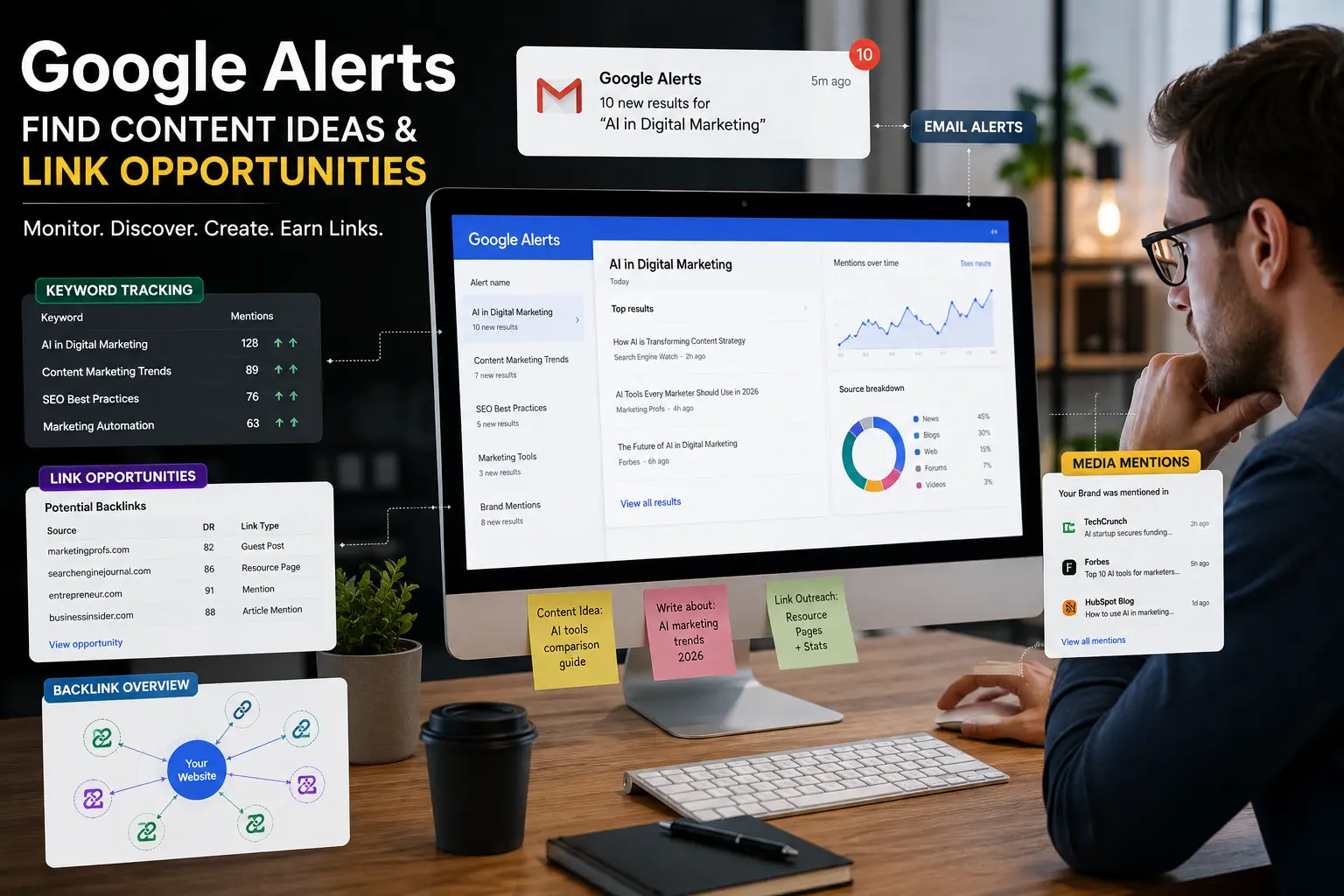
Learning how to use Google Alerts properly can save you an absurd amount of research time.
Most people think it's just a basic notification tool for tracking mentions online. That's part of it, sure. But if you're serious about SEO, content marketing, or digital PR, Google Alerts can quietly become one of your most useful free research tools.
I've seen marketers spend hundreds on monitoring platforms while ignoring a simple setup that already gives them content monitoring insights, brand tracking opportunities, and potential backlinks.
Here's the thing: the value isn't in the alerts themselves. It's in what you do with the information.
If you know how to filter signals from noise, Google Alerts can help you discover article topics, spot outreach opportunities early, and monitor conversations your competitors completely miss.
What Is Google Alerts and Why Does It Matter?
Google Alerts: A free content monitoring tool that sends notifications when new content related to your chosen keywords appears online.
At its core, Google Alerts tracks mentions across indexed web pages, news articles, blogs, and discussions.
You enter keywords.
Google scans for new mentions.
Then you receive updates by email.
Simple.
But the strategic use cases go much deeper than basic notifications.
A well-built alert system can help you:
- Discover trending content topics
- Monitor competitor mentions
- Find backlink opportunities
- Track industry conversations
- Identify journalist requests
- Spot brand mentions without links
- Monitor reputation issues
What most people overlook is timing.
Early awareness matters.
If you're among the first people responding to a new topic, news trend, or industry discussion, your chances of earning visibility and links increase significantly.
That's especially true for smaller websites trying to compete against larger publishers.
[INTERNAL LINK: relevant biphoo.eu page]
Why Google Alerts Still Matters in 2026
Some marketers dismiss Google Alerts because newer SEO tools exist.
Honestly, I think that's shortsighted.
Yes, premium monitoring platforms offer more advanced filtering. But Google Alerts still works surprisingly well for:
- Fast content discovery
- Brand mention tracking
- Media opportunity monitoring
- Early trend detection
- Basic competitor research
And unlike expensive enterprise tools, it doesn't require a budget.
That matters for startups, small businesses, freelancers, and niche website owners.
Search behavior is changing in 2026.
AI-generated content is flooding search results, which means original insights and timely responses matter more now. People are tired of recycled generic articles.
Google Alerts helps you react faster to:
- Emerging discussions
- Industry shifts
- Breaking news
- Viral conversations
- Fresh publishing opportunities
I've personally used alerts to find guest post openings, podcast collaboration requests, and journalist quotes within hours of publication.
Most competitors saw those opportunities days later.
Timing changes outcomes.
One realistic example:
A SaaS startup monitored keywords related to “remote team productivity problems.” Within weeks, they noticed repeated discussions around employee burnout in hybrid workplaces. Instead of publishing another generic productivity guide, they created a focused article addressing remote burnout workflows.
That article attracted backlinks from HR blogs and industry newsletters because it matched a growing conversation early.
No fancy software involved.
Just smart monitoring.
Expert Tip: Create alerts for problem-focused phrases, not only keywords. People often search and discuss frustrations more naturally than marketers expect.
How to Use Google Alerts to Find Content Ideas and Link Opportunities
1. Set Up Alerts Around Core Topics
Start with your primary niche topics.
If you run a marketing website, your alerts might include:
- SEO trends
- Content marketing tips
- Link building strategies
- Email marketing automation
- Local SEO mistakes
Keep your keyword phrases realistic.
Broad keywords usually create noisy alerts.
For example:
“SEO” alone is probably too broad.
“Technical SEO audit checklist” gives cleaner results.
You want useful signals, not endless clutter.
2. Monitor Questions and Pain Points
This is where content idea generation gets interesting.
Instead of only tracking industry phrases, track user frustrations.
Examples:
- Why is my website traffic dropping?
- How to improve email open rates
- Why are backlinks important?
- How to rank local business website
These searches often reveal:
- Repeated beginner questions
- Weak existing content
- Opportunity gaps
- New search intent trends
Here's what most guides miss: audiences usually tell you exactly what content they need.
You just need a system to notice patterns.
3. Track Competitor Brand Mentions
Competitor monitoring can uncover both content opportunities and backlinks.
Set alerts for:
- Competitor brand names
- Competitor founders
- Product names
- Industry influencers
Then study:
- Where they're getting mentioned
- Which topics attract coverage
- Which sites link to them
- What angles journalists use
That information helps shape your own outreach strategy.
In my experience, this works especially well for niche industries where the same websites regularly cover similar companies.
4. Find Unlinked Brand Mentions
This might be one of the easiest link-building opportunities people ignore.
Set alerts for your own:
- Brand name
- Product names
- Founder names
- Website title
Sometimes websites mention your business without linking back.
That's a warm outreach opportunity.
Instead of cold pitching random publishers, you're contacting someone who already referenced your brand.
Your outreach message becomes much easier:
“Thanks for mentioning us. Would you mind linking to the original resource for readers?”
That tends to work surprisingly well.
5. Monitor Industry News for Reactive Content
Reactive content performs better than many evergreen-only strategies.
When major industry news breaks, use it.
Quick response articles can:
- Generate social shares
- Attract backlinks
- Improve visibility
- Build authority
- Increase topical relevance
For example:
If search engines release major ranking updates, SEO websites publishing timely analysis often gain traffic spikes quickly.
Speed matters.
Not rushed low-quality content.
Just timely relevance.
6. Create Alerts for Guest Posting and Media Requests
This one gets overlooked constantly.
Set alerts like:
- Write for us + your niche
- Guest post by
- Looking for contributors
- Expert quotes needed
- Podcast guests wanted
You'll uncover:
- Guest posting opportunities
- Collaboration requests
- Interview invitations
- Expert roundup participation
- PR opportunities
A lot of link-building is really just relationship-building with better timing.
Google Alerts helps surface those openings earlier.
Expert Tip: Don't create too many alerts initially. Ten highly focused alerts usually outperform fifty broad noisy ones.
The Biggest Mistake People Make With Google Alerts
Most people either:
- Set alerts and never check them properly
- Create alerts so broad they become useless
Both problems kill results.
If your inbox gets flooded with irrelevant notifications, you'll eventually ignore them entirely.
That's human nature.
Here's my slightly unpopular opinion.
Google Alerts should support your strategy, not become your strategy.
Some marketers obsess over monitoring tools while barely publishing content themselves.
Monitoring only matters if you actually act on insights.
Another mistake?
Using alerts only for link building.
Honestly, content ideation is often the bigger long-term advantage.
A single timely article inspired by audience conversations can outperform dozens of generic SEO posts.
I've seen tiny niche blogs gain traction simply because they responded to emerging discussions faster than larger competitors.
One example involved a cybersecurity blog tracking discussions around phishing scams targeting remote workers. They noticed repeated news mentions before larger publications covered practical prevention strategies.
Their quick response guide earned backlinks naturally because it solved a growing problem immediately.
That timing advantage mattered more than domain authority.
Expert Tips and What Actually Works
Use quotation marks strategically
Alerts become more precise when you track exact phrases.
For example:
- "email deliverability problems"
- "remote onboarding mistakes"
- "local SEO audit"
This reduces irrelevant noise significantly.
Combine broad and narrow alerts
A healthy setup usually includes:
- A few broad industry alerts
- Several focused topic alerts
- Brand monitoring alerts
- Competitor tracking alerts
- Opportunity-based alerts
That mix creates better coverage without overwhelming your inbox.
Review patterns weekly, not obsessively daily
You don't need to monitor every notification in real time.
Honestly, that becomes exhausting fast.
Weekly review sessions often work better because patterns become clearer over time.
You start noticing repeated questions, publishing trends, and media opportunities.
Build content from repeated signals
One mention means little.
Ten mentions around the same topic?
That's usually a signal worth paying attention to.
Repeated audience concerns often become strong article ideas.
Especially if existing content feels outdated or shallow.
Save promising outreach sources immediately
When you discover:
- Journalists
- Bloggers
- Industry sites
- Podcast hosts
- Resource pages
...save them in a spreadsheet or outreach system.
Otherwise you'll probably forget later.
I've done that more times than I'd like to admit.
Don't chase every trending topic
This matters.
Some trends create traffic but attract the wrong audience.
Not every viral discussion fits your brand positioning.
Traffic without relevance usually converts poorly.
Focus on topics aligned with your niche and long-term authority goals.
Expert Tip: Some of the best backlink opportunities come from smaller niche publishers, not giant websites. Smaller industry blogs often respond faster and value expert contributions more.
People Most Asked About Google Alerts
How often should I check Google Alerts?
For most businesses, reviewing alerts once or twice daily is enough. If you're monitoring breaking news industries like finance, cybersecurity, or technology, more frequent checks might help.
Can Google Alerts help with SEO?
Yes. Google Alerts supports SEO by uncovering content ideas, backlink opportunities, brand mentions, and trending industry discussions that can inspire relevant articles and outreach campaigns.
Are Google Alerts accurate?
They're reasonably useful, but not perfect. Sometimes alerts miss mentions or include irrelevant results. That's why focused keyword selection matters so much.
What keywords should I track in Google Alerts?
Start with:
- Your brand name
- Competitor names
- Industry topics
- Customer pain points
- Guest posting phrases
- Trending niche discussions
Refine over time based on alert quality.
Can small businesses benefit from Google Alerts?
Absolutely. Small businesses often benefit more because they need affordable ways to monitor trends, competitors, and local conversations without expensive software.
How many Google Alerts should I create?
Most people should begin with 5–15 focused alerts. Too many alerts create noise quickly and reduce the chances you'll actually use the information.
Do Google Alerts help with link building?
Yes, especially for unlinked brand mentions, media monitoring, guest posting opportunities, and reactive outreach campaigns.
Learning how to use Google Alerts effectively isn't really about automation. It's about awareness.
The businesses and creators who notice conversations early usually create better content, build stronger relationships, and discover opportunities before competitors react.
You don't need expensive monitoring systems to start.
You need focused alerts, consistent review habits, and the ability to turn insights into useful content and outreach.
If you want to amplify your content visibility even further, combining smart monitoring with professional publishing and promotion support through biphoo.eu can help your content reach wider audiences faster.