

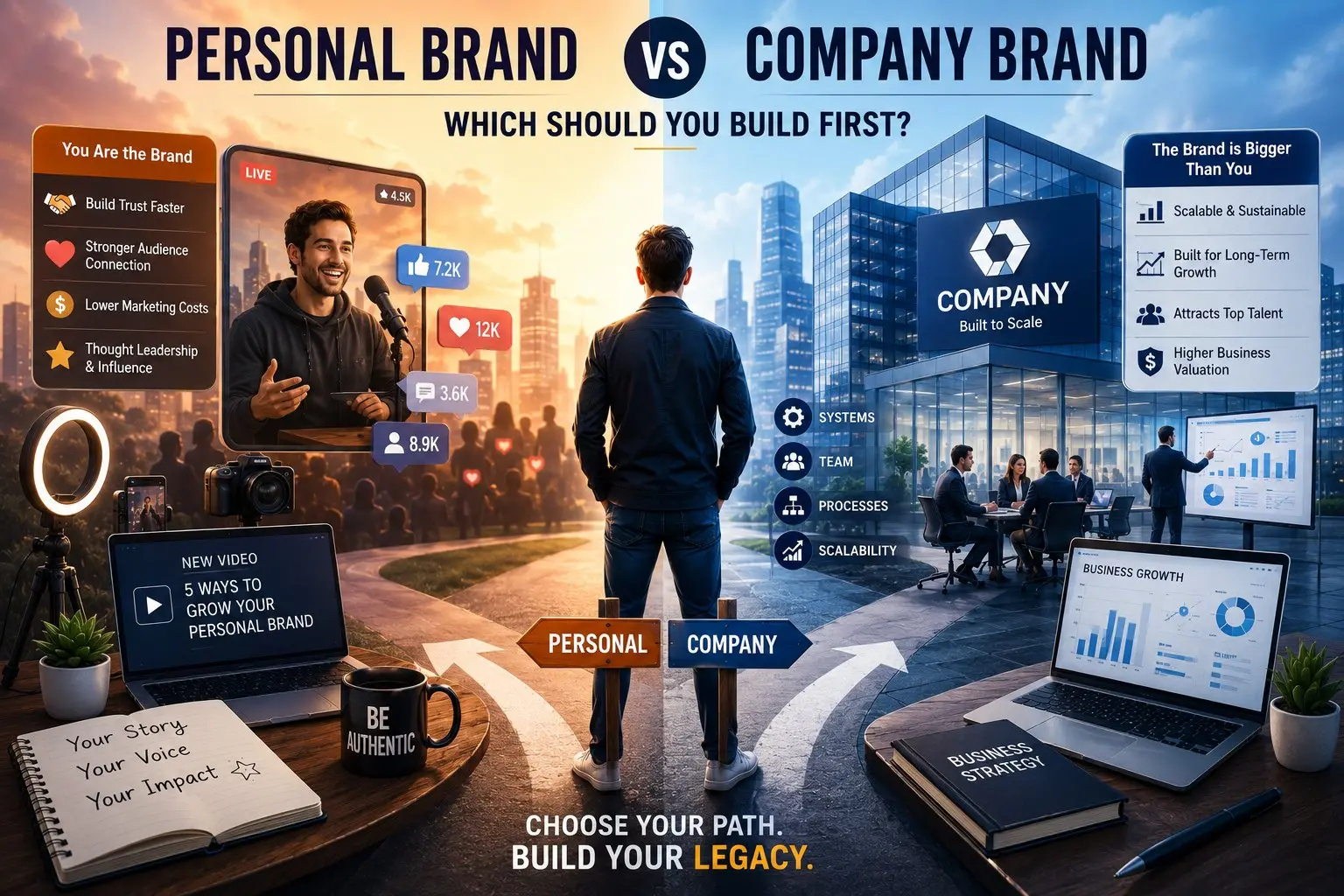
If you are a solo founder, creator, consultant, freelancer, or early-stage entrepreneur, building a personal brand first is usually the smarter move. It helps you gain trust faster, attract attention organically, and establish authority before your company becomes widely recognized.
If you already have a scalable startup, multiple stakeholders, or long-term plans that go beyond one person, focusing on a company brand may be the better path.
For most businesses today, the strongest strategy is a combination of both: use a personal brand to create visibility and trust while gradually building a company brand that can scale independently.
Personal Brand vs Company Brand: Which Should You Build First?
Introduction
One of the most important branding decisions entrepreneurs face today is whether to build their own name first or put all attention on the business brand.
This decision affects:
- Marketing performance
- SEO visibility
- Audience trust
- Customer acquisition
- Hiring opportunities
- Long-term scalability
- Business valuation
The digital landscape has changed dramatically over the past decade. Consumers no longer connect deeply with faceless corporations alone. They follow people, personalities, and founders who share experiences, opinions, and expertise.
At the same time, relying too heavily on one individual can create scalability issues. If customers only trust the founder, growing beyond that person becomes difficult.
That’s why understanding the difference between a personal brand and a company brand matters more than ever.
This guide explains:
- What personal and company branding really mean
- The advantages and disadvantages of each
- Which one works best for different business models
- Real examples from successful brands
- How SEO and AEO influence branding today
- Practical steps to choose the right strategy
What Is a Personal Brand?
A personal brand is the public perception of an individual. It represents your expertise, personality, communication style, values, and reputation.
People follow personal brands because they trust the human behind the content.
Well-known examples include:
- Gary Vaynerchuk
- Alex Hormozi
- Ali Abdaal
- Elon Musk
In these cases, the individual attracts attention first, which then benefits their businesses.
Key Elements of a Personal Brand
A strong personal brand usually includes:
- Thought leadership
- Consistent expertise
- Storytelling
- Public visibility
- Authentic communication
- Audience engagement
- Educational content
Modern platforms like LinkedIn, YouTube, podcasts, newsletters, and X have made personal branding one of the fastest-growing marketing assets.
What Is a Company Brand?
A company brand represents the business itself instead of one person.
It includes:
- Brand identity
- Logo and design
- Company values
- Customer experience
- Messaging
- Product reputation
- Team culture
People trust the organization rather than an individual founder.
Examples include:
- Apple
- Nike
- HubSpot
- Salesforce
Even though some of these companies have famous founders, the brands operate independently from those individuals.
Key Elements of a Company Brand
A strong company brand typically focuses on:
- Consistent customer experience
- Professional positioning
- Product authority
- Team-driven marketing
- Scalable communication
- Visual consistency
This model works especially well for businesses aiming for long-term scalability and acquisition potential.
Why Personal Brands Grow Faster Today
Modern digital platforms naturally favor individuals over corporations.
People engage more with human stories than polished corporate messaging.
A founder sharing practical experiences on LinkedIn often receives far more engagement than a company account posting the same information.
Reasons Personal Branding Works Faster
Trust Builds More Quickly
Consumers are skeptical of traditional advertising but respond positively to authentic expertise and personal experiences.
When founders openly share lessons, challenges, and opinions, trust grows naturally.
Lower Initial Marketing Costs
Personal brands can grow organically through:
- Social media content
- Podcast appearances
- Guest interviews
- Educational videos
- Industry commentary
- Networking
This reduces dependence on paid advertising early on.
Better Organic Reach
Most platforms prioritize creator-led content because audiences interact with it more frequently.
That gives personal brands stronger visibility.
Easier Relationship Building
People respond more readily to individuals than company pages.
Founder visibility can attract:
- Investors
- Partnerships
- Media opportunities
- Clients
- Employees
Stronger Emotional Connection
Audiences often feel emotionally connected to creators and founders.
That loyalty becomes valuable over time.
When a Company Brand Is the Better Choice
Personal branding is powerful, but it is not always the best strategy.
Some businesses benefit more from company-first branding.
Company Branding Makes More Sense If:
You Want to Sell the Business Later
Businesses heavily tied to a founder can become difficult to transfer or acquire.
A company brand creates independent value.
Your Industry Requires Institutional Trust
Certain sectors rely more on organizational credibility than founder personality, including:
- Enterprise software
- Legal services
- Manufacturing
- Healthcare systems
- Financial infrastructure
You Have Multiple Founders
Building visibility around only one founder can create imbalance within the organization.
A company-first identity keeps attention on the business itself.
You Prefer Privacy
Not every entrepreneur wants to become a public-facing personality.
A company brand allows founders to stay more private.
You Want the Business to Scale Beyond You
A scalable company eventually needs authority independent from one individual.
Personal Brand vs Company Brand: Main Differences
| Factor | Personal Brand | Company Brand |
|---|---|---|
| Trust Speed | Fast | Slower initially |
| Scalability | Limited by person | Highly scalable |
| Audience Connection | Emotional | Business-focused |
| Organic Reach | Higher on social media | Lower initially |
| Long-Term Transferability | More difficult | Easier |
| Marketing Costs | Lower early-stage | Higher early-stage |
| Reputation Risk | Tied to individual | Tied to company |
| Content Performance | Often stronger | Depends on authority |
Which Should Startups Build First?
For most startups, founder-led branding is usually the better starting point.
At the beginning:
- Nobody knows the company
- Trust is limited
- Budgets are small
- Visibility is low
A personal brand helps solve these problems faster.
Founders become the distribution channel for their business.
As trust grows, the company brand can gradually expand alongside the founder identity.
The Hybrid Branding Model
Many of today’s fastest-growing businesses use a hybrid approach.
The founder builds:
- Trust
- Visibility
- Audience engagement
- Thought leadership
Meanwhile, the company develops:
- Product systems
- Team authority
- Scalable operations
- Independent reputation
This combination creates both emotional trust and business scalability.
How to Decide Which Brand to Build First
Build a Personal Brand First If:
- You are a solo entrepreneur
- You sell expertise or consulting
- You enjoy content creation
- You rely on networking
- You need affordable marketing
- Your knowledge is part of the product
Build a Company Brand First If:
- You plan to scale aggressively
- You want acquisition potential
- You prefer staying private
- You run a team-focused organization
- Your industry depends on institutional trust
Step-by-Step Branding Strategy
Step 1: Define Your Long-Term Goal
Start by asking:
- Do I want personal influence?
- Do I want a scalable company?
- Am I comfortable being public?
- Will I eventually exit the business?
Your answers shape the branding strategy.
Step 2: Clarify Your Positioning
Every successful brand needs:
- A clear niche
- Audience focus
- Consistent messaging
- Defined expertise
Weak positioning creates weak branding.
Step 3: Create Foundational Content
Content builds visibility, authority, and search presence.
Focus on:
- Educational articles
- Industry insights
- Case studies
- Experience-based lessons
- Problem-solving content
If you're launching a new website, building a structured content strategy from the beginning helps create long-term authority and consistent traffic growth.
Step 4: Build Search Visibility
SEO and AEO are now deeply connected to branding.
Strong search visibility helps:
- Build authority
- Generate evergreen traffic
- Increase discoverability
- Improve trust signals
A smart branding strategy should include:
- SEO-focused articles
- Answer-based content
- Semantic keyword coverage
- Topical authority development
Step 5: Build Audience Relationships
Strong brands interact consistently with their audience.
Use:
- Newsletters
- Comments
- Communities
- Q&A sessions
- Social engagement
Trust compounds over time.
Step 6: Expand Beyond One Platform
Never depend entirely on one social network.
Build:
- Website traffic
- Email lists
- Search rankings
- Multi-platform visibility
Many marketers also use monitoring tools and industry tracking methods to discover new content opportunities and brand mentions.
Common Branding Mistakes
Trying to Look Too Corporate Too Early
Many startups focus on polished branding before earning trust.
People connect with authenticity first.
Building Visibility Without Expertise
Attention alone is not enough.
Long-term authority requires genuine knowledge and experience.
Ignoring SEO
Social media visibility can disappear quickly.
Search traffic compounds over time.
That’s why many successful personal branding strategies also prioritize evergreen SEO content.
Depending Entirely on One Person
If the entire business depends on one individual, scalability becomes risky.
Inconsistent Messaging
Changing positioning constantly confuses audiences.
Consistency builds recognition and trust.
Expert Tips for Faster Brand Growth
Focus on One Core Topic
Narrow expertise grows authority faster than broad messaging.
Share Real Experiences
Audiences trust practical lessons more than theory.
Share:
- Failures
- Wins
- Experiments
- Results
- Observations
Publish Opinion-Based Content
Original opinions stand out more than generic advice.
Combine SEO With Social Media
Social media creates short-term visibility.
SEO builds long-term authority.
The strongest brands use both together.
Build Brand Search Volume
A strong brand creates direct searches on Google.
Examples:
- “Gary Vee marketing”
- “HubSpot CRM”
- “Alex Hormozi business advice”
Branded searches strengthen overall authority signals.
Many businesses combining founder-led content with search visibility create stronger long-term brand growth.
Real-World Branding Examples
Personal Brand First: Gary Vaynerchuk
Gary Vaynerchuk built massive attention through personal content before expanding his businesses.
His audience trust accelerated business growth significantly.
Company Brand First: Apple
Apple became larger than any single individual.
The brand maintains authority regardless of leadership changes.
Hybrid Model: Tesla and Elon Musk
Tesla benefits from both strong company branding and the visibility of Elon Musk.
This creates massive attention but also introduces reputation dependency.
How SEO and AEO Influence Branding
Modern branding is closely connected to search optimization.
SEO Supports Branding By:
- Increasing visibility
- Building topical authority
- Driving organic traffic
- Creating evergreen discoverability
- Improving trust signals
AEO Supports Branding By:
- Winning Featured Snippets
- Appearing in AI Overviews
- Ranking for conversational queries
- Supporting voice search visibility
Brands with strong expertise and consistent publishing are more likely to appear in AI-powered search experiences.
Should You Use Your Own Name or a Brand Name?
Use Your Own Name If:
- You are the expert
- You teach or educate
- You want speaking opportunities
- Your audience connects directly with you
Use a Brand Name If:
- You want broader scalability
- You plan to sell the business
- You want the company to outgrow the founder
- You operate with larger teams
Many entrepreneurs start with personal visibility and gradually strengthen the company brand over time.
The Future of Branding in the AI Search Era
AI-powered search is changing how authority works online.
Search engines increasingly prioritize:
- Trusted experts
- Recognized entities
- Experience-based content
- Reputation signals
- Clear topical authority
This trend benefits:
- Specialized creators
- Consistent publishers
- Founder-led businesses
- Brands with strong expertise
Generic anonymous content is becoming less effective.
FAQ
Is a personal brand better than a company brand?
Not necessarily. Personal brands grow trust faster, while company brands scale more effectively long term.
Can you build both at the same time?
Yes. Many successful businesses combine founder visibility with company authority.
Which branding strategy works best for startups?
Most startups benefit from founder-led branding during the early growth phase.
Does personal branding help SEO?
Yes. Strong personal authority can improve visibility, backlinks, engagement, and branded search demand.
Can a company succeed without a founder brand?
Absolutely. Many large companies operate independently from any individual personality.
What is the biggest risk of personal branding?
The business can become too dependent on one person’s reputation and visibility.
How long does brand building take?
Strong brands typically require years of consistency, quality content, and audience trust-building.
Final Thoughts
The decision between personal brand vs company brand is not about choosing one permanently. It is about choosing the best starting point for your goals.
For many entrepreneurs today, personal branding creates faster momentum because trust travels through people first. Over time, company branding becomes important for scalability and long-term independence.
The strongest businesses often combine both:
- Founder visibility builds trust
- Company branding creates scale
- SEO builds discoverability
- AEO improves answer visibility
- Consistent content builds authority
Businesses that balance human connection with scalable branding are positioned best for the future of digital growth.