

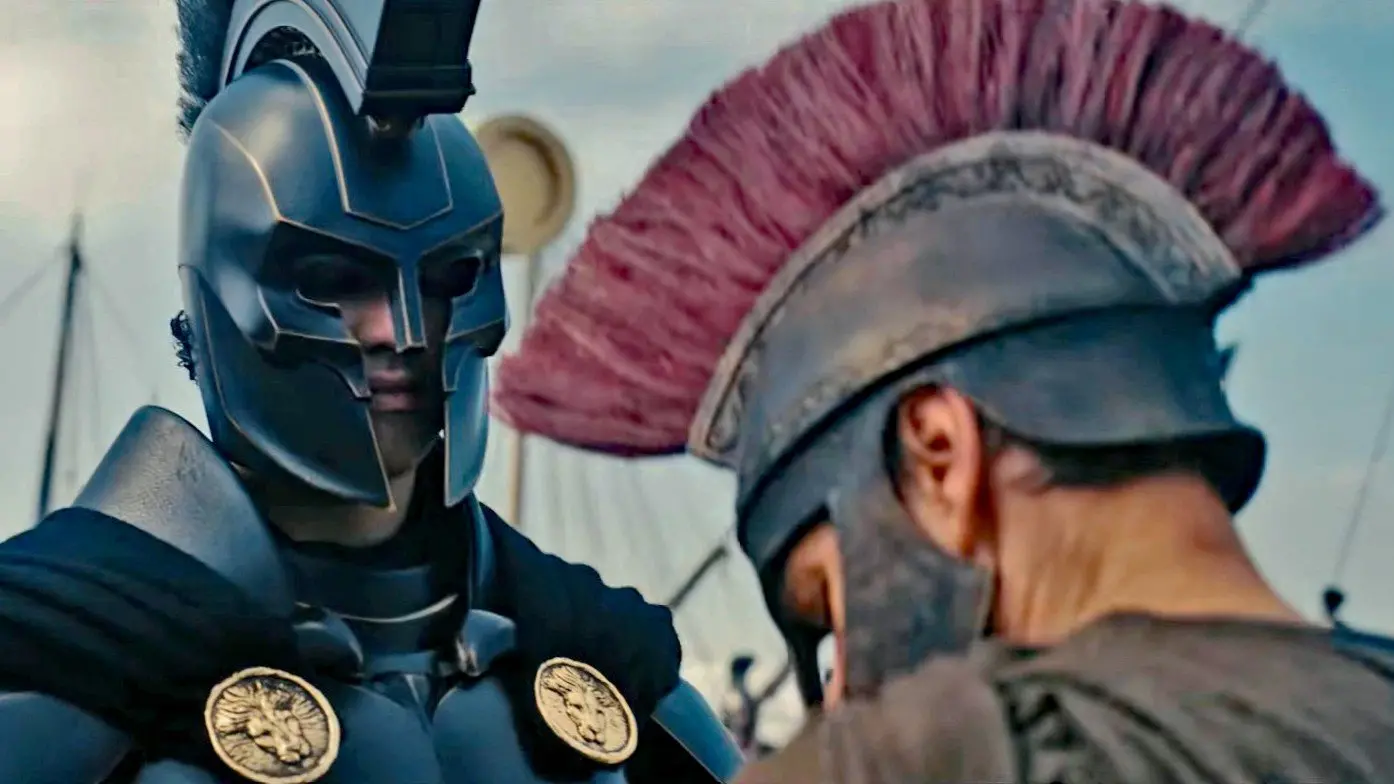
Oscar-winning director Christopher Nolan is no stranger to intense scrutiny, but the Internet backlash against the first trailer for his upcoming epic The Odyssey has prompted a rare public defense. The film, based on Homer's ancient Greek poem, is set for release on July 16, 2026, and boasts a budget of $250 million, massive practical sets, and a star-studded cast including Matt Damon, Anne Hathaway, Tom Holland, Robert Pattinson, and Zendaya. Yet, almost immediately after the trailer dropped, fans took to social media to voice concerns about anachronistic dialogue, armor designs they likened to Batman suits, and the surprising casting of rapper Travis Scott as a bard.
Nolan, known for his meticulous attention to detail in films like Interstellar, Inception, and Oppenheimer, addressed these criticisms in a recent interview with Time Magazine. He argued that the complaints stem from a misunderstanding of both ancient artifacts and the filmmaking process itself. For instance, the armor shown in the trailer—dark, metallic, and elaborate—was not a nod to his own Batman trilogy but was based on actual Mycenaean bronze work from the era. In fact, Nolan revealed that the design team used techniques that ancient Greek artisans might have employed, such as blackening bronze with gold, silver, and sulfur. This, he insisted, was not a creative liberty but an educated speculation grounded in archaeological theory.
The Science of Ancient Storytelling
Nolan drew a direct line between his approach to The Odyssey and the one he took for Interstellar. In the 2014 sci-fi epic, Nolan hired physicist Kip Thorne to ensure the depiction of black holes and time dilation was as scientifically accurate as possible. For The Odyssey, he assembled a team of historians, archaeologists, and classicists to reconstruct the world of the 8th century BCE. “With Interstellar, you ask: ‘What is the best speculation about the future?’ With the ancient past, it’s the same question: ‘What is the best speculation, and how can I use it to build a world?’” Nolan explained. He acknowledged that not every historian will agree with every choice, just as some physicists complained about Interstellar. But his goal, he said, was to avoid the perception that he had been “careless” in his research.
This commitment to speculative realism extends to the film's dialogue. Critics argued that lines in the trailer sounded too modern for characters living in the Bronze Age. However, Nolan pointed out that Homer's original text was written centuries after the events it describes, and that the language of the poem itself is a stylized version of ancient Greek. He argued that a literal translation would be alienating to modern audiences, just as using Attic Greek would be inaccessible. Instead, the screenplay by Jonah Nolan (Christopher's brother) aims for a poetic rhythm that captures the spirit of the epic without archaic phrasing. “We're not making a museum piece; we're making a movie that breathes and lives for contemporary viewers,” Nolan said.
Travis Scott and the Oral Tradition
Perhaps the most unexpected casting decision was that of rapper Travis Scott, who appears as a bard performing what looks like a rap version of the Odyssey. In the trailer, Scott's character is seen chanting verses while strumming a lyre, sparking giggles and ire online. Nolan defended the choice by linking it to the oral tradition from which Homer's work emerged. “The Odyssey was originally passed down through spoken word, often by traveling poets who would embellish and adapt the story. In many ways, that's exactly what rap does today. Travis Scott brings that energy, that improvisational flair, to the role.” The director also noted that Scott prepared extensively for the part, studying ancient musical instruments and meter patterns. Far from a gimmick, Nolan sees it as a thematic through-line connecting the ancient and modern worlds.
The decision to cast Scott has also reignited debates about representation in historical epics. The bard character was initially written as a generic storyteller, but Nolan said he wanted a performer who could embody the transformative power of live performance. “We could have cast a classically trained actor, but that would have felt safe. Travis brings an edge, a contemporary relevance that mirrors how Homer's story was constantly reinvented.” This aligns with Nolan's broader philosophy that historical films should not be staid textbooks but dynamic, emotionally resonant experiences.
Practical Effects and the 70mm IMAX Revolution
Beyond the controversy, The Odyssey is notable for being the first feature film shot entirely with 70mm IMAX cameras. Nolan has long been a champion of large-format film, using it for sequences in Dunkirk and Oppenheimer. But for this project, he committed to the format from the first day of principal photography to the last. The result, according to those who have seen early footage, is a visual spectacle that rivals anything in the director's filmography. Practical sets—including a full-scale replica of Odysseus's palace in Ithaca and a 100-foot-tall replica of the cyclops Polyphemus's cave—were built rather than rendered in CGI. Nolan believes that tangible environments elicit stronger performances from actors and create a more immersive experience for audiences.
His insistence on practical effects also extends to the film's action sequences. The trailer shows a brutal depiction of the Trojan War, with thousands of extras in bronze armor clashing on a muddy battlefield. While 300 and Troy used heavy digital manipulation, Nolan's approach is more grounded, emphasizing the weight and wear of armor, the squelch of mud, and the exhaustion of soldiers. “The Odyssey is not just a fantasy; it's a story about survival, cunning, and endurance. Those themes demand a tactile reality,” Nolan explained.
Cast and Character Insights
The film's ensemble cast has been kept largely under wraps, with production avoiding the usual fanfare of character reveals. However, Time Magazine's interview confirmed a few key details: Lupita Nyong'o will play a dual role as Helen of Troy and her sister Clytemnestra. This casting decision adds a layer of dramatic irony, as Helen's abduction and the subsequent Trojan War are the catalyst for Odysseus's journey. Nyong'o's performance is said to emphasize the twin sisters' contrasting fates—one immortalized as the face that launched a thousand ships, the other condemned to a life of grief and revenge.
Meanwhile, Robert Pattinson—who previously worked with Nolan on Tenet—plays Antinoos, the most aggressive of Penelope's suitors. Pattinson reportedly underwent intense physical training to embody the arrogant nobleman, and his scenes with Anne Hathaway's Penelope are described as „psychologically charged.“ Tom Holland, stepping away from his Spider-Man persona, portrays Telemachos, Odysseus's son. Holland's character arc involves a coming-of-age journey as he searches for news of his father, a subplot that Nolan has expanded significantly from the original poem. Zendaya, as the goddess Athena, serves as both a narrator and a deus ex machina, appearing in mortal form to guide Telemachos and Odysseus.
The Broader Context of Fantasy Criticism
The backlash against The Odyssey is part of a larger cultural conversation about historical accuracy in fantasy and period films. In recent years, productions like The Last Kingdom, Gladiator II (2024), and even House of the Dragon have faced similar accusations of anachronism. Nolan's response, however, is distinct: rather than simply dismissing critics, he frames his choices as part of a dialogue between past and present. He notes that every generation reinterprets the classics—Shakespeare's plays were performed in Elizabethan costumes, not Roman togas. “Art is not a photograph of history; it's a prism that refracts the past through contemporary sensibilities.”
This philosophy is evident in the film's treatment of mythology. While staying faithful to Homer's narrative arc—Odysseus encounters the Cyclops, Circe, the Sirens, and descends into the Underworld—Nolan and his screenwriter have added layers of psychological depth. For example, the Sirens are not just seductive monsters but manifestations of Odysseus's own guilt and longing. “It's a very human story about temptation and perseverance,” Nolan said. “The monsters are metaphors for internal struggles.”
The controversy also underscores the high stakes involved. With a $250 million budget, The Odyssey is one of the most expensive independent films ever made (produced by Syncopy and distributed by Universal). Nolan's reputation for box-office success—Oppenheimer earned nearly $1 billion—means that any misstep could be magnified. Yet the director remains unfazed. He noted that similar criticisms were leveled at Interstellar before its release, with skeptics mocking the idea of a cornfield farmer saving humanity. That film went on to become a beloved classic. “I hope audiences enjoy the movie even if they don't agree with every choice. What I want them to feel is that we cared—deeply about getting it right, even when we had to guess,” Nolan concluded.
As the release date approaches, the debate over The Odyssey will likely intensify. But Nolan's willingness to engage with critics—and to defend his creative decisions with detailed archaeological and narrative reasoning—suggests a filmmaker confident in his vision. Whether that vision will resonate with audiences remains to be seen, but one thing is clear: Christopher Nolan is not making a safe film. He is making a bold, speculative, and deeply personal interpretation of one of the Western world's foundational stories.
Source: KINO News